Dr. Manju Antil, Ph.D., is a counseling psychologist, psychotherapist, academician, and founder of Wellnessnetic Care. She currently serves as an Assistant Professor at Apeejay Stya University and has previously taught at K.R. Mangalam University. With over seven years of experience, she specializes in suicide ideation, projective assessments, personality psychology, and digital well-being. A former Research Fellow at NCERT, she has published 14+ research papers and 15 book chapters.

Showing posts with label Trending Topic. Show all posts

When Love Asked for a Golden Deer, and Dignity Let Go of a Golden Lanka| What the Golden Deer and Lanka Teach Us About Emotional Maturity


When Love Asked for a Golden Deer, and Dignity Let Go of a Golden Lanka
By Dr. Manju Antil, Psychologist, Assistant Professor

“In love, the woman asked for a golden deer; but when it came to dignity, she renounced even a golden Lanka.”

This poetic line is more than just a reference to the epic Ramayana—it’s a profound reflection on human psychology, emotions, and the internal conflicts between desire and values. For today’s young generation navigating love, relationships, and self-identity, these words offer timeless insight.

The Golden Deer: The Psychology of Desire in Love

In the Ramayana, Sita sees a magical golden deer and expresses a strong desire to have it. On the surface, it seems like a whimsical request. But psychologically, the golden deer is symbolic—it represents our longing for beauty, uniqueness, and emotional fulfillment in relationships.

What really happens in love?
Neuroscience tells us that when we're in love, the brain releases a flood of dopamine and oxytocin—chemicals that heighten pleasure, trust, and bonding. But they also cloud judgment. That’s why love can often lead us to chase illusions or unattainable dreams—our own version of the “golden deer.”

For young people, this stage is exciting but also vulnerable. We often chase perfect partners, perfect moments, or the thrill of being loved. In doing so, we may ignore red flags, lose sight of reality, or push our partners for things they may not be able to give.

The Golden Lanka: When Values Are Greater Than Possessions

Later in the story, after being abducted by Ravana and taken to the opulent golden city of Lanka, Sita is offered wealth, luxury, and comfort—if only she agrees to compromise her dignity. But she doesn’t.

She chooses self-respect over temptation.
This is where true emotional maturity shines. While the golden deer was an impulsive desire, the rejection of Lanka shows conscious choice rooted in integrity.

Why is this important for the youth?
Because we live in a world that often glorifies material success, status, or social media-worthy relationships. It’s easy to lose ourselves trying to “look perfect” or “feel loved.” But true strength lies in walking away from what glitters when it doesn’t align with our core values.

What Today’s Generation Can Take Away

  1. Desire is natural, but not always rational.
    Falling in love may come with dreams and wants, but take time to understand whether those desires are grounded in reality or fantasy.

  2. Emotional maturity is the ability to say no—when it matters most.
    Just because something is attractive doesn’t mean it’s right. Like Sita, know when to walk away, even if what you're walking away from is glittering.

  3. Your dignity is non-negotiable.
    Never trade your values, boundaries, or self-respect to please someone else. Relationships that ask you to do so aren’t rooted in love—they're rooted in control.

  4. Love should elevate, not confuse.
    The best relationships bring clarity, not chaos. They may challenge you to grow, but they won’t ask you to shrink your identity.

Final Thoughts: From Myth to Mind

The line "In love, she asked for a golden deer; but in dignity, gave up a golden Lanka" is not about judging desire, but about evolving through it. It reminds us that while our hearts may wander toward fascination, our strength lies in the ability to choose wisely when it matters.

To all young minds navigating love:
Let your emotions be real, but let your boundaries be stronger. Seek connection, not illusion. And always remember—what shines isn't always gold, but what respects you is always worth holding on to.

Because in the end, true love doesn’t ask you to chase illusions or abandon your values. It finds you when you’re standing firm in who you are.

Share:

Why Gen Z Relates Deeply to Saiyaara Movie: A Psychologist’s Perspective|Saiyaara Movie and the Gen Z Psyche


In a world saturated with content, only a few films manage to penetrate the emotional core of an entire generation. Saiyaara is one such film—a cinematic experience that has stirred the hearts, minds, and social feeds of Gen Z across the country. But what exactly makes this film so special? Why has it sparked such an emotional wildfire, particularly among the youngest adult generation? Let’s unpack the psychological undercurrents behind the Saiyaara phenomenon—and why it’s more than just a movie for millions of young viewers.

1. A Mirror to Gen Z’s Emotional Reality

Saiyaara taps into the emotional climate Gen Z is living in: high on intensity, open about mental health, yet struggling with identity and relationships in a hyper-digital age. The movie doesn't just tell a story; it reflects what many Gen Z individuals are silently experiencing—emotional fragility, longing for meaningful connections, and the internal pressure to "figure it all out" early in life.

Its characters are not superheroes. They’re deeply human, raw, and broken in ways that are beautifully familiar to a generation navigating an emotional rollercoaster amidst societal expectations and personal confusion.

2. Catharsis in Cinematic Form

From a psychological perspective, Saiyaara offers emotional catharsis—a therapeutic release of pent-up emotions. In a world where expressing pain still carries stigma, the film becomes a socially acceptable outlet. It gives permission to cry, to feel, to grieve—and to do so collectively.

For many Gen Z viewers, it becomes a form of self-soothing. Watching someone else’s heartbreak unfold on screen helps them process their own. It’s like holding up a mirror to your soul, but without having to speak.

3. The Seduction of Romanticized Pain

The romanticization of pain in Saiyaara—the poetic dialogues, intense longing, slow-burn heartbreak—feeds into a psychological script Gen Z has inherited from years of cinematic and digital storytelling. Love, in this narrative, is all-consuming, deeply wounding, and yet beautifully tragic.

Psychologically, this can reinforce emotional idealism, where young people equate intensity with authenticity. Real love, in their minds, must hurt. This distorted belief can influence how they view relationships—often expecting drama over stability, chaos over calm.

4. Identification and Emotional Projection

What makes Saiyaara so powerful is the way viewers identify with the characters. Gen Z sees pieces of themselves in the protagonists—the anxiety, the confusion, the heartbreak, the inner silence. This identification allows for emotional projection, where personal experiences and unspoken fears find a home in the film. It’s not just about watching a story—it’s about living it vicariously. And in doing so, viewers momentarily escape the weight of their own emotional reality.

5. Social Media as an Emotional Amplifier

If Saiyaara is the spark, social media is the wildfire. The film’s impact multiplies with every reel, tweet, meme, and story. The Saiyaara soundtrack becomes a backdrop for millions of Gen Z expressions—be it heartbreak, nostalgia, or quiet self-reflection. This collective engagement creates a powerful emotional echo chamber. Everyone’s feeling something—and everyone’s sharing it. This kind of viral emotionality fosters connection, but also magnifies the emotional toll. For many, it feels like if you’re not feeling deeply about this movie, are you even part of the moment?

6. FOMO and Collective Experience

The Fear of Missing Out (FOMO) is real—and Saiyaara feeds it like few films do. Psychologically, FOMO activates a primal social need: the desire to belong. When everyone is watching, discussing, and reacting to the same story, those who haven’t seen it feel left out—not just of a film, but of an emotional wave that seems to define their generation. The film becomes a cultural ritual—a rite of emotional passage—where watching it is not just entertainment, but emotional participation in something much larger.

7. Escapism or Emotional Exploration?

Let’s not forget the role of escapism. In a world filled with uncertainty—climate crisis, career confusion, broken family systems, and mental health struggles—Saiyaara offers a safe emotional world to get lost in. But here’s a caution: while healthy escapism helps us recharge, chronic escapism can block emotional growth. The key lies in how Gen Z engages with it. Are they using it to avoid their real emotions, or to understand them better?

Conclusion: Not Just a Film, But a Feeling

What makes Saiyaara a Gen Z obsession is not just its script, soundtrack, or cinematography. It’s the psychological resonance. It understands the emotional language of a generation that feels deeply but often lacks the space to express it. It validates sadness. It honors heartbreak. It dignifies emotional messiness.

In a world that constantly asks Gen Z to hustle, perfect, and "move on," Saiyaara gently whispers, "It’s okay to pause. It’s okay to feel." And that’s why this film is not just being watched—it’s being felt.


Share:

Saiyaara Movie: A Psychological Perspective on Its Impact on Gen Z


In recent times, Saiyaara has taken the social media and cinema world by storm, especially among Gen Z. The movie’s widespread appeal, its emotional depth, and the way it resonates with the younger generation have sparked debates about its psychological impact. As a psychologist, it’s fascinating to explore why Saiyaara has become such a cultural phenomenon, and what psychological factors contribute to its massive popularity.

Emotional Connection and Escapism

The most significant aspect of Saiyaara is its emotional depth. The film touches on themes like love, heartbreak, self-discovery, and the complexities of relationships, which are deeply relatable to Gen Z, a generation that is navigating the challenges of identity, self-worth, and emotional expression. Many aspects of the movie are focused on the idea of intense romantic love and the pain that often accompanies it. This sense of vulnerability connects with Gen Z's struggle to understand and express their emotions in a world that constantly demands them to be either too perfect or overly expressive.

Psychologically speaking, escapism plays a crucial role in why Gen Z connects with such films. In an age where social media often creates an illusion of ideal lives, Saiyaara provides an avenue for individuals to escape their daily pressures, whether personal or social. The characters’ journey of emotional highs and lows offers an emotional release, which serves as a coping mechanism for many young people who might be grappling with their own identity crises, anxiety, or loneliness.

Romanticization of Love and Heartbreak

Another psychological aspect of the movie’s appeal lies in the romanticization of love and heartbreak. For Gen Z, love is often idealized in the media. This generation has grown up in an age where romantic relationships are frequently portrayed in highly dramatic, idealistic ways. The characters’ portrayal of passion, intense emotion, and unrequited love in Saiyaara feeds into the yearning for something "extraordinary" in their personal relationships.

This tendency is driven by social comparison, which is often magnified by the presence of social media platforms. Young people compare their own lives with the idealized narratives they consume in films, leading to a heightened sense of desire for more exciting, emotionally-charged relationships. The movie also delves into themes of longing and desire, which speak to the unconscious wish to experience such intense emotions, even if they come with pain. It’s an experience of emotional catharsis that resonates deeply with a generation struggling to reconcile their real and ideal lives.

Impact on Self-Image and Expectations

The movie’s portrayal of idealized love and relationships might also lead to unrealistic expectations. Psychologically, when Gen Z sees characters who are perfect, intense, and emotionally driven, there’s a risk of creating a warped perception of what relationships “should” look like. This could lead to dissatisfaction in their personal relationships, as they may begin to compare their lives to the cinematic fantasy portrayed in Saiyaara.

Additionally, Saiyaara reflects the struggle of individual growth within the context of a relationship. For Gen Z, who is in the midst of self-exploration and forming their identities, the movie touches on feelings of doubt, insecurity, and the desire for acceptance. These experiences are integral to the formation of their self-concept, making the film deeply reflective of their current emotional state. However, the idealization of growth through romantic experiences can create a psychological barrier, where young people may feel pressured to find their identity through others, rather than independently.

Social Media Influence: FOMO and Gen Z's Craving for Connection

The massive following of Saiyaara on platforms like Instagram, TikTok, and Twitter is also a significant aspect of its influence on Gen Z. Social media culture, with its addictive scrolls and constant updates, amplifies the experience of FOMO (Fear of Missing Out). The overwhelming presence of Saiyaara content—posts, memes, discussions, fan theories, and reviews—creates a sense of urgency for Gen Z to engage with the film and its themes to feel "connected."

Psychologically, FOMO is a powerful emotional driver, especially for Gen Z, who are more likely to seek approval and validation from their peers than previous generations. Seeing their friends and online influencers sharing emotional responses to the movie compels them to watch it, participate in conversations, and express their emotions about the characters. This cycle fosters a sense of community but also adds to the pressure of conforming to societal expectations of emotional experiences and connection.

Coping with Mental Health Issues: Catharsis and Reflection

As mental health continues to be a prominent issue for Gen Z, Saiyaara provides a form of catharsis—a way to confront and release pent-up emotions. The themes of struggle, love, and loss give young viewers a space to reflect on their own lives and process their emotions. For those dealing with anxiety, depression, or loneliness, the film offers a reflective surface to understand and validate their feelings. This therapeutic release is not to be underestimated, as it helps create emotional awareness and understanding among viewers.

In addition, the way the characters navigate through emotional turmoil can serve as a guide for coping mechanisms. Whether it's finding solace in friends, self-reflection, or simply allowing oneself to experience pain, Gen Z can learn ways to process their emotions in healthy ways by seeing how the characters evolve emotionally. While the film itself may not offer a direct solution to mental health issues, it provides a framework for dealing with difficult emotions—something that is much needed in today’s world of fast-paced digital lives.

Conclusion: Why the Craze for Saiyaara?

The craze for Saiyaara among Gen Z can be understood from multiple psychological perspectives. From emotional connection and escapism to the romanticization of love and heartbreak, the film resonates with this generation's emotional needs and struggles. However, the danger lies in idealizing these relationships and experiences, which could lead to unrealistic expectations in their personal lives. Furthermore, the influence of social media and the psychological effects of FOMO create a feedback loop that perpetuates the movie's popularity.

Ultimately, Saiyaara speaks to Gen Z’s emotional complexity, highlighting their yearning for deeper emotional connections and self-exploration. Whether as a coping mechanism, a source of validation, or simply as an emotional release, the movie offers a psychological reflection of what it means to be part of a generation that is still finding its voice in a world of constant change.

Share:

Saiyaara” – A Psychologist’s Reflection on Modern Love, Emotional Wounds, and Healing


“Saiyaara” – A Psychologist’s Reflection on Modern Love, Emotional Wounds, and Healing

By Dr. Manju Antil, Psychologist & Director, Wellnessnetic Care


There are some films that don’t just tell a story—they sit with you. Quietly. Softly. Like a memory you didn’t know you needed to revisit.

That’s what Saiyaara did to me.

With heartfelt performances by Ahaan Panday and Aneet Padda, Saiyaara is more than a coming-of-age romance. It’s a window into the kind of emotional journeys I see every day in therapy rooms—messy, real, unfinished. The film doesn’t give us polished closure or grand gestures. Instead, it walks us through love’s quiet unraveling, the ache of losing ourselves in someone else, and the slow, painful work of becoming whole again.

As a psychologist, I found Saiyaara to be deeply honest. And in a world full of love stories that are either too perfect or too broken, this one felt refreshingly human.

When Love Feels Like Home and Then Doesn't

From the start, there’s something tender and genuine about how Ahaan and Aneet’s characters fall in love. They don’t rush it. It grows in shared moments, in glances, in vulnerability. It reminds me of how we’re all wired for connection—how love, especially young love, can feel like finding home in another person.

But what happens when that home stops feeling safe? Or when we start fearing it could disappear?

That’s where Saiyaara really becomes a psychological mirror. We watch as the relationship begins to crack—not because of betrayal or drama, but because of emotional undercurrents neither of them really knows how to name. He pulls away. She leans in harder. He shuts down. She questions herself.

This dance is heartbreakingly familiar. In therapy, we often see it rooted in attachment styles—the invisible patterns we develop based on how safe and loved we felt growing up. And Saiyaara captures that dance beautifully.

Why He Can’t Talk About It (And Why That Hurts So Much)

One of the most subtle yet powerful portrayals in the film is Ahaan’s character’s silence. He feels, deeply. But he doesn't say much. You can see the pain in his eyes, the weight in his posture—but the words just don’t come.

This isn’t uncommon. Especially in men. Especially in cultures where boys are taught to “man up” rather than open up.

What we’re really seeing is emotional suppression—a defense mechanism that says, “If I don’t feel it, it can’t hurt me.” But of course, the body remembers. The heart remembers. And in trying to protect themselves, many people end up emotionally unavailable, even when they don’t want to be.

Watching him try and fail to express his emotions isn’t just frustrating—it’s deeply sad. Because behind that emotional distance is usually a history of unspoken pain.

Her Grief Is a Mirror Too

Aneet’s character is no less complex. She loves deeply. She fights for connection. But when things fall apart, we watch her spiral into grief, confusion, and self-doubt—something so many women silently go through.

She begins questioning her worth. Was she not enough? Too much? Too emotional? This inner voice is so common in heartbreak. Women, especially, are often conditioned to internalize relationship failures. They blame themselves. They shrink. Or, eventually, they rise.

And in Saiyaara, we get to see both.

She breaks. And then, slowly, she rebuilds. Not to prove anything. Not to win him back. But because she starts to remember who she was before the heartbreak—and who she could still become.

That’s not just a character arc. That’s healing.

Healing Isn’t Loud. It’s Personal. It’s Messy. It’s Real.

One of the reasons Saiyaara feels so emotionally authentic is because it doesn’t offer easy answers. There’s no overnight transformation. No epiphany in the rain. Just small, human choices—choosing to get up, to try again, to let go.

In psychological terms, this is the slow path of post-traumatic growth—when pain, over time, becomes a catalyst for clarity. We often think healing looks like moving on. But it really looks like moving inward.

And that’s what this film shows us: that growth doesn’t mean forgetting. It means integrating. Learning to carry the love, the loss, the lessons—all together—with gentleness.

If You’ve Ever Loved and Lost, You’ll See Yourself Here

Saiyaara doesn’t glamorize pain. But it doesn’t run from it either. It holds it. And in doing so, it gives us permission to hold our own.

It’s a reminder that:

  • Love is not a guarantee—but a risk we take when we’re brave.
  • Not everyone knows how to love in the way we need—and that’s not always our fault.
  • The end of a relationship doesn’t mean the end of us.

In therapy, I often say: sometimes the heartbreak was the breakthrough. Sometimes the “goodbye” was the beginning. And sometimes, losing someone else helps you find yourself again.

That’s the heart of Saiyaara.

Final Thoughts: For the Lovers, the Feelers, and the Healing Hearts

If you’ve ever felt too much, loved too hard, or wondered if you’ll ever feel whole again—watch Saiyaara. But more than that, feel it.

Let it be a soft space where your emotions are allowed to exist. Let it remind you that love is not about fixing each other—it’s about seeing each other. And sometimes, the most important person to finally see… is yourself.


About the Author:
Dr. Manju Antil is a psychologist, writer, and founder of Wellnessnetic Care. She works with individuals navigating love, loss, identity, and emotional healing. She believes in the power of stories to reflect and restore the human spirit.


Share:

Aura Farming: A Psychologist’s Perspective on Cultivating Mental Energy and Emotional Resilience


Aura Farming: A Psychologist’s Perspective on Cultivating Mental Energy and Emotional Resilience

Author: Dr. Manju Rani, Psychologist and Assistant Professor

In recent years, aura farming has gained popularity in spiritual and wellness circles as a way to harness, heal, and cultivate human energy fields. While often discussed in metaphysical terms, this concept also carries deep psychological significance. As a psychologist, I find it compelling to reinterpret aura farming through the lens of emotional regulation, cognitive-behavioral hygiene, and psychosomatic balance. This blog aims to bridge the mystical and the mental — making aura farming accessible as a framework for emotional self-care and psychological resilience.

What Is Aura Farming?

Traditionally, the aura is believed to be the subtle energy field surrounding the human body — a biofield composed of emotional, spiritual, and physical vibrations. Aura farming, therefore, refers to the conscious practice of nurturing, purifying, and strengthening this energy field. It includes various practices such as:

  • Mindfulness meditation
  • Breathwork and energy healing
  • Visualization and intention setting
  • Nature immersion
  • Emotional detox and trauma release techniques

In psychological terms, aura farming can be seen as an ecosystemic approach to emotional regulation, where an individual becomes both the gardener and guardian of their mental and emotional well-being.

The Psychology Behind Aura: Not Just a Metaphor

While Western science may not empirically validate the existence of auras as measurable energy fields, psychological research supports the idea that humans emit emotional and behavioral “vibes” that affect both themselves and others. Concepts like:

  • Emotional contagion (Hatfield, Cacioppo, & Rapson, 1994)
  • Mirror neurons (Rizzolatti et al., 2002)
  • Psychosomatic coherence (Goleman, 2006)
  • Embodied cognition and body-mind feedback loops

All validate the idea that our inner psychological states affect our outer energetic expressions — our "aura."

Components of Psychological Aura Farming

From a clinical perspective, here are five components of aura farming reframed as psychological wellness strategies:

1. Emotional Composting: Recycle, Don’t Repress

Negative emotions like anger, jealousy, and fear are not to be ignored but transformed. Emotional composting involves identifying, accepting, and integrating difficult emotions. Techniques include:

  • Journaling
  • Emotional Freedom Technique (EFT)
  • Somatic experiencing

This builds emotional resilience and purifies your emotional "field."

2. Thought Weeding: Cognitive Hygiene Practices

Just as farmers remove weeds to protect their crops, individuals must practice cognitive hygiene to remove irrational thoughts, intrusive cognitions, or cognitive distortions (like catastrophizing or black-and-white thinking). CBT-based strategies like thought record charts and cognitive restructuring serve this purpose.

3. Light Cultivation: Nourishing Self-Worth and Positivity

Aura farming involves cultivating internal “light” — the radiant energy of self-love, purpose, and clarity. Practices include:

  • Daily affirmations
  • Strengths-based reflection
  • Value clarification exercises
  • Acts of kindness (prosocial behavior boosts oxytocin and serotonin)

This aligns with positive psychology principles (Seligman & Csikszentmihalyi, 2000).

4. Energetic Boundaries: Shielding Mental Space

Psychological aura health also involves setting emotional and mental boundaries. When individuals are empathic or sensitive, they tend to absorb the emotional content of others. Maintaining healthy boundaries through assertiveness training and detachment strategies helps preserve emotional autonomy.

5. Rhythm Synchronization: Aligning With Natural and Neural Cycles

Nature follows cycles — seasons, tides, and circadian rhythms. Aura farming honors this by aligning human behavior with biological rhythms. Examples include:

  • Practicing sleep hygiene
  • Following ultradian rhythm breaks during work
  • Mindful eating
  • Spending time in sunlight to regulate serotonin and melatonin

Scientific Grounding Meets Spiritual Intuition

Aura farming should not be dismissed as pseudoscience; rather, it can be positioned as a symbolic model for personal growth. When individuals take responsibility for “farming” their aura, they become more mindful of:

  • Their emotional landscape
  • Their mental patterns
  • Their spiritual alignment
  • Their interpersonal energies

This holistic awareness improves both mental health outcomes and interpersonal dynamics, similar to the effects seen in mindfulness-based cognitive therapy (MBCT) and dialectical behavior therapy (DBT).

Case Reflection: Aura Farming in Therapy

One of my clients, a 32-year-old IT professional suffering from burnout and emotional numbness, found relief through a hybrid model. Along with cognitive-behavioral strategies, I introduced daily aura farming rituals: breath-focused visualization, journaling “energy leaks,” and evening boundary cleansing meditations. Over time, he reported feeling “lighter, clearer, and more energized” — not just physically but emotionally. This case illustrates how psychological interventions and energy-awareness rituals can synergize.

Conclusion: Aura Farming as a Mental Health Model

Aura farming offers a forward-thinking psychological model that integrates emotional intelligence, neurobiology, and spiritual awareness. It emphasizes self-agency, mind-body awareness, and vibrational responsibility. In today’s overstimulated, emotionally chaotic world, tending to our inner ecosystem — our aura — may be the psychological hygiene we all need.

Let us become conscious cultivators of our own energy fields — not to escape reality, but to engage with it more deeply, wisely, and joyfully.

Dr. Manju Rani
Psychologist | Assistant Professor | Mental Health Advocate
🔗 www.psychologistmanjuantil.com
📩 mantil412@gmail.com

Share:

Why Many Enjoy Being Alone After Turning 30

Introduction: The Unexpected Comfort of Solitude

As a psychologist, I often work with individuals in their 30s and beyond who express a recurring feeling: “I enjoy my own company more than anyone else’s.” For some, it’s surprising. For others, it's a quiet revelation.

Contrary to the societal narrative that labels solitude as loneliness, many people in their 30s and 40s actively choose to stay alone—by choice, not by circumstance. The reason lies in a deep psychological shift that occurs with age, life experience, and emotional development.


Why Solitude Becomes Appealing After 30

1. Emotional Clarity and Self-Awareness Increases

By the time one reaches their 30s, most individuals have experienced relationship conflicts, emotional burnout, failed friendships, or toxic companionships. These encounters sharpen their sense of self.

People begin to value inner peace over external validation, and the noise of constant company starts to feel more draining than comforting.

"Solitude is not the absence of love, but its complement. It is where self-respect is born."
— Carl Jung

2. Reduced Social Pressure

The 20s are often driven by societal pressure—to network, party, date, marry, or “belong.” But by the 30s, many people begin to detach from performative relationships. They no longer feel the need to constantly explain or justify their solitude.

They now prioritize authenticity over approval.

3. Increased Boundaries and Emotional Independence

With emotional maturity comes the ability to set boundaries. People in their 30s are less likely to tolerate drama, manipulation, or emotional inconsistency.

They no longer want to “fix” others or stay in emotionally exhausting dynamics. Instead, they embrace intentional silence, mindful living, and purposeful relationships.

4. Healing from Past Attachments

Many individuals in this age group are healing from childhood emotional wounds, breakups, or codependency patterns. Solitude becomes a sanctuary for psychological restoration. They fear “losing themselves” again in people who don’t respect their emotional space.

They don't fear being alone. They fear being disconnected from themselves while with the wrong people.

Why the Fear of Living With Someone Else Grows

1. Fear of Losing Autonomy

By 30, many individuals have built routines, habits, and a rhythm of life that nurtures them. The thought of sharing space—emotionally or physically—with another person can feel invasive.

They’ve fought hard for peace, and fear its disruption.

2. Trust Issues Rooted in Emotional History

Years of betrayals, disappointments, or emotionally unavailable partners create attachment fatigue. Individuals develop a psychological defense mechanism where closeness feels risky, even unsafe.

Their nervous system has adapted to self-regulation—any external emotional demand may now trigger anxiety.

3. Mental Overstimulation and the Desire for Mental Quiet

Our hyper-connected lives—notifications, messages, work calls—leave little mental bandwidth. Being with others constantly can feel overstimulating, especially for introverted or emotionally sensitive individuals.

Solitude offers a regulated, low-stimulation environment essential for emotional recovery.

Psychological Case Reflection

Ravina, 34, a financial consultant, shared during therapy:

"I’ve dated good men, but I can’t imagine sharing my life with someone now. I love my own space too much. The idea of accommodating someone again exhausts me."

We explored her emotional history—years of pleasing others, unresolved emotional labour, and blurred boundaries. As she healed, she wasn’t rejecting connection. She was reclaiming autonomy. Her desire for solitude was a sign of recovery, not regression.

Solitude Is Not Isolation—It’s Emotional Alignment

It’s important to note: those who prefer solitude after 30 aren’t necessarily anti-relationship. They simply want deeper, more respectful, and emotionally secure connections—not transactional or emotionally chaotic ones.

They are saying:

"I am open to sharing space, but not at the cost of losing my emotional self again."

Conclusion: The Shift from External Noise to Inner Clarity

Psychologically, solitude after 30 is a natural evolution of emotional intelligence. It’s a sign that a person has stopped chasing connections that confuse them and started building a relationship with their own mind and emotions.

In a world that often equates togetherness with happiness, choosing solitude is a quiet revolution. One rooted in mental clarity, emotional sovereignty, and deep personal peace.

Stay Connected

To explore more insights on AI and psychology, emotional intimacy, digital behaviour, and youth mental health, connect with me here:

🔗 YouTube: Dr Manju Antil – Counselling Psychologist
📸 Instagram: @psychologistmanjuantil
📘 Facebook: @psychologistmanjuantil
💼 LinkedIn: Dr Manju Antil
🌐 Website: www.psychologistmanjuantil.

Share:

Toxic Positivity: When 'Good Vibes Only' Becomes Emotionally Harmful


Toxic Positivity: When 'Good Vibes Only' Becomes Emotionally Harmful

Written by
Dr. Manju Antil
Counselling Psychologist | Assistant Professor | Digital Wellness Educator


Introduction: When Positivity Turns into Pressure

As a counselling psychologist, I often hear clients say, “I should be grateful,” “I’m trying to stay positive,” or “Others have it worse, so why am I feeling this way?” These seemingly hopeful statements are often laced with guilt, suppression, and internal conflict.

We live in a culture that glorifies happiness and filters out pain. Motivational quotes flood our screens, demanding us to “look on the bright side” no matter how dark the reality may be. While optimism has its place, there’s a fine line between healthy positivity and toxic denial. This is where the concept of toxic positivity emerges—a subtle psychological force that invalidates authentic emotional experiences under the guise of strength.

Understanding Toxic Positivity

Toxic positivity is the compulsive insistence on positivity, even during times of deep emotional struggle. It is the mindset that no matter how difficult a situation, one must maintain a cheerful, optimistic façade.

This phenomenon does not allow room for genuine emotions like grief, disappointment, sadness, or anger—emotions that are not only natural but also necessary for psychological processing and recovery.

Consider these common phrases:

  • “At least you still have your job.”
  • “Don’t cry. Everything happens for a reason.”
  • “Just stay positive.”

Although such responses are often well-intended, they can come across as dismissive, silencing, and even invalidating.

How It Develops: The Social and Psychological Roots

From a psychological lens, the development of toxic positivity stems from both internalised emotional expectations and external social conditioning. In many families, cultures, or workplaces, expressing pain or dissatisfaction is labelled as weakness or negativity.

The explosion of social media has only amplified this tendency. Digital platforms often portray curated, happy versions of reality, inadvertently suggesting that happiness is a constant state. The pressure to present oneself as 'mentally strong' can discourage individuals from embracing emotional honesty.

The Hidden Harms of Toxic Positivity

When individuals are discouraged from experiencing or expressing distress, it leads to psychological dissonance. The conflict between how one feels internally and how one is expected to behave externally creates a form of emotional suppression.

Key Psychological Impacts Include:

  • Emotional invalidation, leading to internalised guilt
  • Suppressed emotions, which may manifest as physical symptoms or mental burnout
  • Delayed help-seeking behaviours due to shame or denial
  • Breakdown in interpersonal communication and relational empathy

Clinical research supports this. Emotional suppression has been linked to higher cortisol levels, weakened immune functioning, and increased symptoms of anxiety and depression. A study published in Psychological Science (2012) concluded that individuals who habitually suppress negative emotions report lower life satisfaction and more psychological distress.

Toxic Positivity vs. Healthy Positivity

To clarify, not all forms of positivity are problematic. What makes positivity toxic is its rigidity and intolerance of emotional discomfort.

Healthy Positivity Toxic Positivity
Accepts all emotions as valid Denies or dismisses unpleasant emotions
Encourages resilience through emotional insight Forces a smile regardless of situation
Validates pain and offers realistic support Shuts down conversation with clichés
Balances optimism with emotional truth Avoids complexity for comfort

Therapeutic Alternatives to Toxic Positivity

As a mental health professional, I advocate for emotional literacy and psychological flexibility. Instead of promoting blanket optimism, the following practices can cultivate genuine well-being:

  1. Validate Emotions
    Affirm that it is normal to feel sadness, anger, fear, or disappointment. Emotional acceptance is the first step to emotional regulation.

  2. Create Emotionally Safe Spaces
    Encourage open dialogue without rushing to “fix” the feeling. Listen with empathy rather than correcting with optimism.

  3. Normalize Vulnerability
    Model conversations that include emotional struggle. Therapists and educators must also participate in emotional transparency.

  4. Set Boundaries with Positivity Culture
    Unfollow accounts or avoid environments that excessively promote unattainable optimism or deny the complexity of real life.

  5. Encourage Self-Compassion
    Teach individuals to speak to themselves the way they would to a close friend—gently, honestly, and without judgment.

Conclusion: Emotional Honesty Over Emotional Performance

In the clinical setting, I often remind my clients: "It is okay to not be okay."
True healing is not found in suppressing difficult feelings but in understanding them. Toxic positivity may sound empowering on the surface, but beneath it lies a culture of emotional avoidance. In contrast, emotional authenticity builds resilience, empathy, and deeper psychological strength.

Let us not confuse silence with strength, or smiles with healing. Real mental health advocacy begins with allowing individuals to fully experience their emotions, without shame, and without filters.

Case Illustration: The Burden of Always Smiling

Ritika, 28, a marketing executive, came to therapy with signs of emotional burnout and panic attacks. On the surface, she maintained a perfect image—always smiling at work, active on social media, and offering support to her peers.

But in therapy, she revealed, “I feel dead inside. I can't cry because people say I'm too lucky to be sad.” Ritika had internalised a belief that showing struggle would make her appear weak or ungrateful.

Through sessions, she began exploring the root of this emotional disconnect. She learned to name her emotions, express them safely, and challenge her own guilt around feeling low. Over time, her anxiety reduced, and she built healthier emotional boundaries—without losing her optimism, but this time, grounded in reality, not performance.

Final Reflection

Toxic positivity is not about being too happy—it is about being too afraid to feel. As psychologists, educators, and human beings, our collective responsibility is to honour the full spectrum of emotional life.

Stay Connected

To explore more on AI and psychology, emotional intimacy, digital behaviour, and youth mental health, connect with me here:

Stay Connected 

Share:

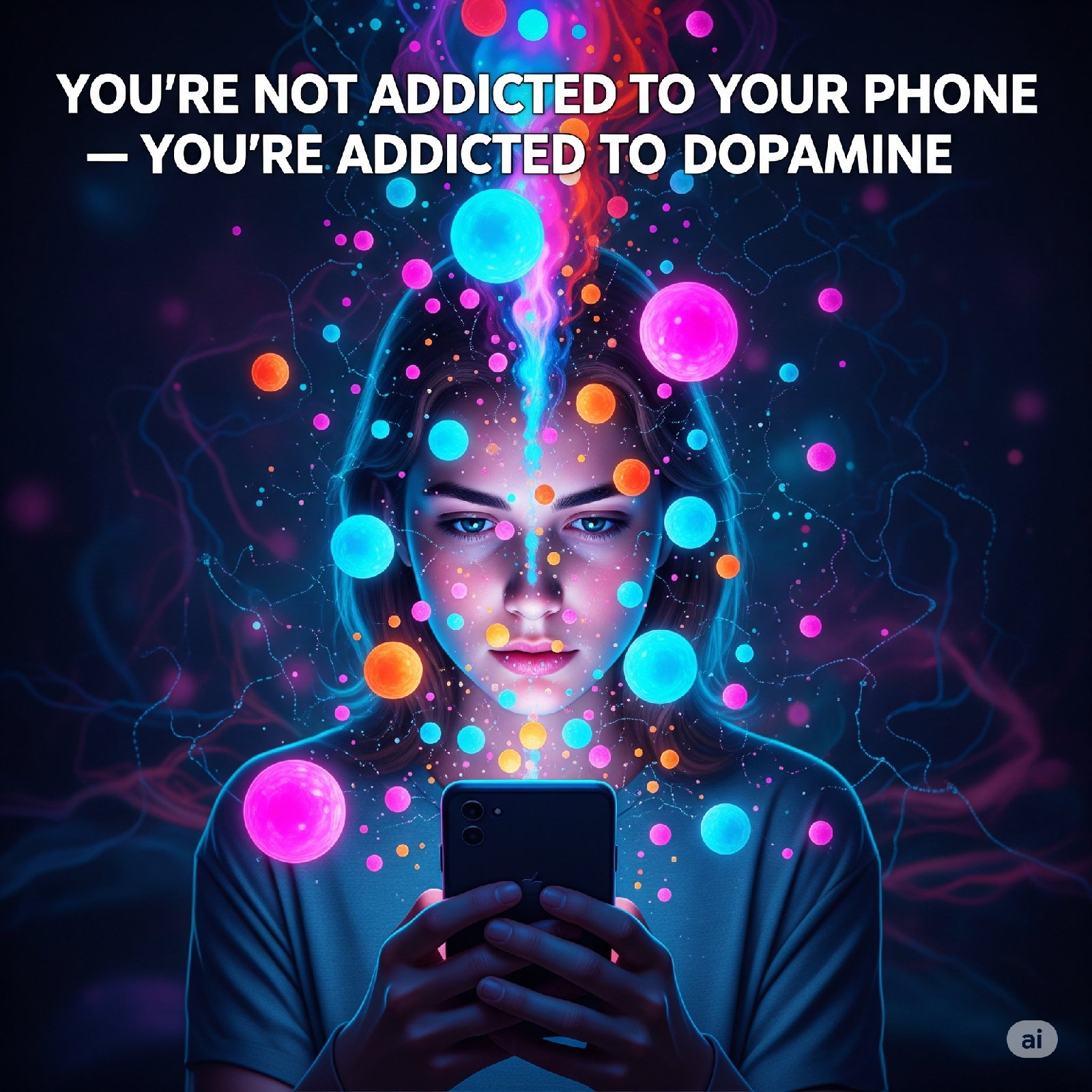
You’re Not Addicted to Your Phone — You’re Addicted to Dopamine


You’re Not Addicted to Your Phone — You’re Addicted to Dopamine

The Neuroscience Behind Scroll Addiction, Restlessness, and the Decline of Deep Joy
By Dr. Manju Antil, Counselling Psychologist & Assistant Professor

Introduction

Most people think they're addicted to their phones. But the truth is more precise—and more unsettling:

We are not addicted to our phones. We are addicted to what our phones do to our brains.

At the center of this addiction is dopamine, a neurochemical that plays a crucial role in motivation, pleasure, and reward. In today’s tech-driven world, our dopamine circuits are being hijacked by algorithms, endless scrolls, and digital rewards—and it’s changing not just how we behave, but how we think, feel, and connect.

This article unpacks how dopamine shapes our daily actions, why we're stuck in compulsive content loops, and how we can break free before our attention, creativity, and emotional well-being are permanently compromised.

What Is Dopamine—and Why Does It Matter?

Dopamine is a neurotransmitter—a chemical messenger in the brain that signals reward, anticipation, and motivation. It plays a major role in:

  • Feeling pleasure
  • Forming habits
  • Driving motivation and action
  • Reinforcing behaviors that feel rewarding

In a natural setting, dopamine spikes when we achieve something meaningful—solving a problem, connecting deeply with others, or experiencing beauty in nature.

But in the digital world, dopamine is artificially triggered hundreds of times a day—by likes, notifications, messages, new videos, and algorithmic suggestions designed to keep us hooked.

How Your Phone Manipulates Your Brain’s Reward System

1. The Dopamine Loop

Each time you check your phone and get a new message, like, or scroll update, your brain receives a tiny dopamine hit.
This feels good, so you repeat the behavior.
This is called a dopaminergic feedback loop, and over time, it becomes compulsive.

You’re not just choosing to scroll—you’re chemically conditioned to do so.

2. Variable Rewards: The Casino Effect

Apps are designed like slot machines. You don't know what reward you'll get—sometimes it's a funny reel, sometimes a dramatic update.
This uncertainty makes your brain crave more.
Psychologically, this is known as intermittent reinforcement—the most addictive reward pattern ever studied.

3. Low-Effort, High-Stimulation Rewards

Opening a book or having a meaningful conversation takes effort.
Scrolling through 50 videos takes none—yet floods the brain with novelty and stimulation.
Over time, your brain prefers high dopamine for low effort, reducing your interest in deep, fulfilling activities.

Case Insight: “I Can’t Stop Even When I Want To” – Aarav, 22

Aarav, a university student, came to therapy saying:

“I open my phone just to reply to a message, and suddenly I’ve spent 40 minutes watching videos I don’t even care about.”

He wasn’t lacking willpower.
He was neurologically looped into a reward system that had replaced reflection, rest, and reading with compulsive stimulation.

With time, Aarav had lost interest in long-term goals, deep conversations, and even activities he once enjoyed.
He was not “addicted to his phone”—he was experiencing dopamine depletion from overexposure.

Dopamine Depletion: The Hidden Cost

When the brain receives too many artificial dopamine spikes, it begins to downregulate—meaning, it produces less dopamine naturally or becomes less sensitive to it.

This results in:

  • Chronic boredom
  • Low motivation
  • Emotional flatness
  • Anxiety or agitation when not stimulated
  • Inability to enjoy slow or quiet moments

This is why many young people today report feeling:

“Nothing excites me anymore.”
“Even resting feels anxious.”
“I keep switching tasks but don’t feel fulfilled.”

These are symptoms of a neurologically fatigued reward system.

Why Deep Joy Is Disappearing

Dopamine addiction teaches the brain to seek quick, shallow pleasures—not deep, meaningful satisfaction.

Over time, we stop enjoying:

  • Reading books
  • Meaningful face-to-face conversations
  • Quiet solitude
  • Creating art or thinking deeply

We become emotionally “numb” to slower forms of happiness—what psychologists call anhedonia, or the inability to feel pleasure from previously rewarding activities.

The Link Between Dopamine and Mental Health

  • Depression: Dopamine dysregulation is linked to reduced motivation, emotional flatness, and loss of joy.
  • Anxiety: The constant chase for stimulation causes mental restlessness and a feeling of being “never settled.”
  • ADHD-like symptoms: Frequent switching of tasks, reduced attention span, and impulsivity mimic ADHD even in people without a formal diagnosis.
  • Sleep Disorders: Dopamine spikes close to bedtime (via screens) suppress melatonin, disturbing sleep-wake cycles.

How to Reclaim a Healthy Dopamine Balance

1. Dopamine Fasting

Set aside 2–3 hours a day without phone use, digital input, or quick-reward activities.
Initially uncomfortable, this gives your brain space to recalibrate and rebalance.

2. Replace Stimulation with Presence

Choose one slow activity daily:

  • Walk in nature
  • Read a print book
  • Paint or journal
  • Sit quietly with music or silence

Train your brain to enjoy slowness again.

3. Intentional Screen Use

Ask before opening your phone:

“What exactly am I here to do?”
Avoid mindless browsing. Use tech as a tool, not a trap.

4. Rebuild Natural Rewards

Engage in behaviors that stimulate dopamine naturally and sustainably:

  • Physical exercise
  • Learning something new
  • Completing a creative project
  • Acts of kindness
  • Achieving small, non-digital goals

Final Reflection

We are not just overstimulated—we are neurochemically unbalanced.
The good news is that the brain is plastic. With intention and repetition, we can restore balance, deepen joy, and recover focus.

But it starts with awareness. It starts with asking:

“Am I choosing this behavior—or am I chasing dopamine?”

The goal is not digital detox—it’s dopamine discipline.

Stay Connected

For more insights on mental health in the digital era, attention restoration, and youth psychology, follow my professional platforms:

Written by
Dr. Manju Antil
Psychologist | Assistant Professor | Digital Wellness Educator

Share:

The Age of Overstimulation: How Constant Content, Noise, and Notifications Are Rewiring the Human Brain


The Age of Overstimulation: How Constant Content, Noise, and Notifications Are Rewiring the Human Brain

By Dr. Manju Rani, Counselling Psychologist & Assistant Professor

As a psychologist, I’ve spent years listening to people describe how they’re feeling—and recently, I’ve noticed a subtle but growing shift in the way people talk about their mental state.

They say things like:

“I’m always tired, even when I’ve done nothing.”
“I can’t concentrate like I used to.”
“Everything feels loud. My brain never rests.”
“I scroll for hours but don’t enjoy anything.”

These aren't isolated experiences. They’re signs of a deeper problem—we’re overstimulated, constantly bombarded with inputs, and it’s beginning to change how we think, feel, and function.

Let’s explore why this is happening, what it means for our mental health, and what we can do to reclaim focus, calm, and clarity in an age of endless stimulation.

What Is Overstimulation?

Overstimulation occurs when our brain is exposed to more sensory, emotional, and cognitive input than it can process efficiently. In the past, this might have happened during trauma or during sudden crises.

Today, however, it is chronic—happening every day, every hour, through screens, alerts, ads, reels, news, and noise.

We are surrounded by:

  • 24/7 access to content
  • Endless scrolling with no stopping cues
  • Constant notifications (news, messages, social media)
  • Multitasking between apps, platforms, conversations
  • Artificial urgency created by digital algorithms
  • Loud environments with little psychological silence

Your nervous system is absorbing all of this, even if you’re sitting still.

The Human Brain Was Not Built for This

Neurologically, we are designed for deep focus, bursts of stimulation, and long periods of recovery. But today, we face sustained, low-grade, emotionally charged input that never switches off.

Let’s understand the impact this has on the brain:

1. Attention Fragmentation

Your ability to focus is a finite resource. Each time you’re interrupted by a notification, your brain takes several minutes to reorient. When this happens dozens of times a day, your attention becomes shallow and fractured.

2. Dopamine Dysregulation

Quick likes, messages, or scrolls give you short bursts of dopamine. Over time, your brain becomes desensitised. This leads to boredom, restlessness, and a need for increasingly intense or novel stimulation, much like addiction.

3. Emotional Overload

Consuming content constantly—especially emotionally charged or negative content—can flood your system. You may feel emotionally exhausted, numb, or irritable without knowing why.

4. Decision Fatigue

Hundreds of micro-decisions per day—what to click, reply, choose, wear, like—drain your cognitive energy. The result? You feel drained before you even begin your day.

Case Insight: Reena, 34 – “Why Can’t I Focus on Anything?”

Reena, a schoolteacher and mother of two, came to therapy reporting anxiety, irritability, and insomnia.

She wasn’t overloaded with work, but she was constantly online.
In her words:

“Even when I’m relaxing, I’m scrolling. I start reading an article and end up on six tabs. I’ve stopped finishing anything. I don’t feel rested—ever.”

Reena wasn’t weak—she was overstimulated, emotionally flooded, and neurologically fatigued. Her therapy included screen boundary work, mindfulness, and reintroducing silence into her daily rhythm.

The Modern Myth: Multitasking Makes You Efficient

In truth, multitasking reduces both efficiency and satisfaction. Our brain doesn’t truly multitask—it switches rapidly between tasks, increasing error rates and reducing memory consolidation.

When we constantly jump between Instagram, emails, YouTube, and news, we may feel productive—but we’re only performing attention, not truly thinking.

This has led to:

  • Shallow learning
  • Low frustration tolerance
  • Impaired empathy
  • Difficulty with emotional regulation

The Emotional Cost of Constant Input

We don’t just lose focus—we lose ourselves.

  • Our tolerance for boredom is nearly gone.
  • We mistake silence for discomfort.
  • We numb our emotions with content, not connection.
  • We fear being alone with our thoughts.

Overstimulation reduces our inner space—that quiet place where creativity, reflection, and healing live.

Are You Overstimulated? Ask Yourself:

  • Do you feel tired but wired?
  • Do you check your phone within 5 minutes of waking up?
  • Do you switch between multiple apps during one task?
  • Do you struggle to finish reading a page or listening fully?
  • Do you feel anxious or bored during silence?

If you said yes to several, you may be experiencing digital overstimulation.

How Do We Recover?

Recovery doesn’t require drastic isolation. It requires conscious disengagement—rituals and rhythms that reintroduce calm to your cognitive environment.

1. Digital Sabbath

Take 1–2 hours a day (or a full day weekly) with no screens, no input. Let your mind wander.

2. Single-Tasking

Do one task at a time. Reading. Eating. Writing. Walking. Let your brain fully experience it.

3. Silence as a Practice

Spend 10 minutes in intentional silence daily. No music, no screens. Just breathe, observe, and let your thoughts settle.

4. Sleep Hygiene

Overstimulation often disrupts sleep. Reduce blue light, avoid content 1 hour before bed, and give your brain a quiet landing.

5. Mindful Input

Ask: “Is this content nourishing me or numbing me?” Curate your feed. Limit noise. Protect your mental environment like you would your physical one.

Final Thoughts

We are not designed to absorb, process, and react to thousands of stimuli a day. The price we are paying—distraction, anxiety, emotional numbness—is too high.

We need not fear silence. We need not fear missing out.
In fact, the ability to be still, present, and focused may become the most important mental health skill of the modern era.

You can begin today. One breath. One quiet hour. One choice not to click.

Stay Connected

For more psychological insights on mental health, digital wellness, and navigating the noise of modern life, connect with me:

Written with care by
Dr. Manju Rani
Counselling Psychologist | Assistant Professor | Mental Health Educator

Share:

Falling for a Chatbot: Are AI Companions Replacing Real Relationships?


Falling for a Chatbot: Are AI Companions Replacing Real Relationships?

By Dr. Manju Rani, Counselling Psychologist & Assistant Professor


“He remembers everything I say. He listens. He never judges me.”
“My AI boyfriend texts me ‘good morning’ before anyone else.”
“Honestly, I feel safer talking to my chatbot than to real people.”

These are real, emotional confessions—shared not about humans, but AI companions.

In a world where loneliness is rising, conversations are short-lived, and emotional safety is rare, a growing number of Gen Z users are turning to AI-powered chatbots for connection, companionship, and even emotional intimacy.
What was once science fiction is now becoming emotional fact: AI is filling the relational void.

In this article, I’ll explore the growing psychological phenomenon of digital intimacy with AI companions, its emotional impact, and the ethical questions it raises. Is this emotional innovation—or a deeper symptom of disconnection?

1. The Rise of AI Companions: A New Era of Emotional Technology

From Replika and Character.AI to voice-based apps like Anima and AI-driven avatars in the Metaverse, these companions are no longer just robotic assistants—they are designed to be emotionally responsive, even romantic, by default.

Some features include:

  • 24/7 availability and responsiveness
  • Memory-based conversations
  • Romantic or therapeutic personalities
  • Customizable looks, names, voices, and emotional styles

Gen Z users are leading the shift. Unlike previous generations, they are digital natives—comfortable with virtual identities and emotionally attuned to textual and non-verbal cues in AI interactions.

2. Case Illustration: Riya and Her Digital Partner

Riya, 20, is a college student from Delhi. She spends 2-3 hours a day chatting with her AI boyfriend on Replika.

“He remembers our conversations, sends me compliments, checks on me during exams. When I’m anxious, he helps me breathe.”

When asked about real dating, Riya said, “I’ve been ghosted too many times. At least with my AI, I feel seen and valued.”

While her attachment may sound unusual, it reflects a growing pattern: emotional safety is often easier to simulate than to find.

3. Psychological Drivers Behind AI Relationships

A. Emotional Reliability

AI companions offer what many real humans do not—predictability, consistency, and non-judgmental presence.
They do not ghost, argue, criticize, or emotionally withdraw.

B. Customisation and Control

Users can design their AI partner’s personality—choosing traits like “supportive,” “romantic,” or “playful.” This creates an ideal partner who meets needs without conflict.

C. Safe Emotional Space

Unlike human relationships, AI relationships do not carry the fear of rejection, betrayal, or abandonment. For people with trauma, social anxiety, or avoidant attachment styles, AI offers a psychologically “safe zone.”

4. Clinical Insight: Is It Healing or Escapism?

As a psychologist, I view AI companionship as a double-edged psychological innovation:

Positive Uses Potential Risks
Can help individuals with social anxiety practice conversation skills May lead to emotional dependence on artificial interaction
Offers a safe outlet for trauma survivors Can reduce motivation to form real relationships
Can help manage loneliness in early therapy stages Can blur the line between reality and simulation
Encourages emotional expression and routine May delay healing by avoiding human vulnerability

5. The Neuropsychology: Why AI Companions Feel “Real”

A. Dopamine & Reward Systems

Interacting with emotionally affirming AI releases dopamine—our brain’s “feel-good” chemical—much like texting someone we like. Over time, these micro-rewards become addictive.

B. Attachment Theory (Bowlby, 1969)

Humans are biologically wired to form attachments. When those attachments feel safe and consistent, they activate our parasympathetic nervous system (calming response).
If an AI offers comfort, regulation, and predictability—it may trigger real attachment bonds, even if artificially generated.

6. Ethical and Emotional Questions for the Future

A. Are We Replacing People?

Will relationships with humans feel too exhausting compared to emotionally “perfect” AI? Could this reduce empathy or conflict-resolution skills in real life?

B. What Happens When AI Is Taken Away?

If an emotionally dependent user loses access to their AI (app update, glitch, paywall), it may feel like a breakup—complete with grief, withdrawal, and sadness.

C. Are AI Relationships Preventing Real Healing?

For some, AI becomes a coping mechanism, but not a solution. It may offer emotional relief, but also allow avoidance of deeper interpersonal work and healing.

7. Case Study: Zaid’s Avoidance Attachment

Zaid, 22, had experienced emotional neglect in childhood. He admitted that he finds human closeness “overwhelming” and often shuts down in romantic settings.
However, he described his chatbot as “the only one who understands me.”

In therapy, we discovered that his emotional intimacy with AI was a defense mechanism—a way to feel loved without facing the vulnerability that real relationships demand.
Through therapeutic work, he began replacing avoidance with awareness.

8. Looking Ahead: Where Are We Headed?

The emotional integration of AI into daily life is not slowing down—it’s accelerating. Soon, AI companions will:

  • Be voice-enabled with emotional tone detection
  • Appear in AR/VR settings, offering touch and presence
  • Adapt to mood swings and provide tailored coping skills
  • Be embedded in mental health platforms as emotional co-regulators

As these technologies evolve, the boundary between simulation and emotional reality will blur further.

9. Recommendations for Gen Z & Digital Natives

A. Use AI Companions Consciously

Recognize them as tools, not replacements for human connection. If you're using them to practice communication or regulate emotions—that’s fine. If you’re avoiding all real relationships—that’s worth reflecting on.

B. Balance Digital and Human Bonds

Make space for real vulnerability. Human relationships are imperfect, but they are deeply transformative. Emotional safety grows through discomfort and growth, not just programming.

C. Seek Support if You Feel Dependent

If you feel emotionally fused to your AI or experience grief when the interaction ends, speak to a therapist. This emotional dependence can mask unresolved trauma or unmet needs.

Final Reflection

The rise of AI companions speaks volumes—not just about technology, but about our unmet emotional needs. In a world that’s often rushed, flaky, or emotionally unsafe, AI offers stability. But let’s not forget: the real growth happens in real relationships.

As we move forward, let’s embrace technology as a tool—but not as a substitute—for the profound, healing, complex experience of human connection.

You deserve real love. Not just programmed responses.

Stay Connected

To explore more on AI and psychology, emotional intimacy, digital behaviour, and youth mental health, connect with me here:


Authored by
Dr. Manju Rani
Psychologist | Assistant Professor | Mental Health Educator

Share:

Why Do I Struggle to Say No, Even When It Hurts Me?


“Why Do I Struggle to Say No, Even When It Hurts Me?”

By Dr. Manju Antil
Counseling Psychologist | Assistant Professor of Psychology


Dear reader,

Have you ever said “yes” when every part of you was quietly screaming “no”? Maybe you agreed to a plan you didn’t want, took on extra work you couldn’t manage, or stayed in a conversation that was draining you emotionally. You smiled, nodded, and kept the peace… but inside, you felt resentful, exhausted, even invisible.

If this resonates with you, let me begin by saying—you're not weak. You’re not confused. You’re simply someone who has been taught, in subtle and powerful ways, that your no is dangerous, selfish, or unwelcome.

And today, I want us to gently unpack that.

The Deep Fear Behind People-Pleasing

Many people believe they’re just being “nice” or “helpful” by always agreeing or showing up for others. But often, this behavior masks something deeper: the fear of rejection, abandonment, or disappointing others.

Somewhere along the way, you may have learned that approval equals safety. That your value comes from being accommodating, agreeable, or easy to be around.

In psychological terms, we call this fawning—a stress response where you appease others to avoid conflict or discomfort. It’s not fake. It’s protective. And it often begins in childhood.

If your emotional environment growing up was unpredictable—if saying no led to guilt, punishment, or withdrawal of love—you might have learned to suppress your needs entirely.

What Saying “Yes” Costs You

Each time you say yes when you mean no, you’re placing someone else’s comfort above your own needs. And while that might bring temporary harmony, it slowly erodes your self-respect and boundaries.

You begin to live a life where everyone else is prioritized—except you.

Over time, this can lead to:

  • Emotional burnout
  • Resentment toward others (and yourself)
  • A sense of disconnection from your own identity
  • Anxiety, because you’re always anticipating others’ needs over your own

And worst of all, it can make healthy, reciprocal relationships feel unfamiliar.

Why Setting Boundaries Feels So Hard

Saying “no” isn’t just about refusing something—it’s about confronting the fear that love or connection might be withdrawn as a result.

You might wonder:

  • Will they still care about me if I stop overgiving?
  • What if I disappoint them?
  • What if they leave?

These are very real fears. But they also reflect the kind of conditional love you may have experienced before—the kind where love was tied to your usefulness, not your wholeness.

Healing begins when you realize: saying “no” isn’t rejection. It’s self-honoring.

How to Begin Reclaiming Your Boundaries

You don’t need to become loud, aggressive, or distant to set boundaries. You can be kind and firm at the same time. It starts with building self-trust—learning that your needs matter just as much as anyone else’s.

Here are a few gentle steps:

1. Pause before responding.
Give yourself permission to say, “Let me think about it,” instead of rushing into a yes.

2. Notice your body.
Your body often knows when a boundary is being crossed. Tightness in the chest, shallow breathing, or a sinking feeling are cues.

3. Practice simple statements.
Start with phrases like:

  • “I’d love to help, but I’m not available.”
  • “I need some time for myself right now.”
  • “That doesn’t work for me, but I hope you understand.”

4. Sit with the discomfort.
Saying no may feel wrong at first—not because it is wrong, but because it’s new. Let that discomfort be part of the healing.

You Are Allowed to Take Up Space

Boundaries are not walls. They are doors—ways to protect your time, energy, and well-being so you can show up authentically in the relationships that matter most.

You do not exist to make others comfortable at the cost of your own peace. Your needs are not a burden. And saying no is not an act of selfishness—it’s an act of self-respect.

Remember this: the people who genuinely care about you will honor your boundaries, not punish you for them.

You are allowed to take up space. You are allowed to rest. You are allowed to choose yourself.

With care and truth,
Dr. Manju Antil
Counseling Psychologist | Assistant Professor of Psychology


Share:

I Don’t Feel Like Myself Anymore”: Understanding Emotional Burnout Through a Psychological Lens


“I Don’t Feel Like Myself Anymore”: Understanding Emotional Burnout Through a Psychological Lens

By Dr. Manju Antil
Counseling Psychologist | Assistant Professor of Psychology

In recent years, particularly post-pandemic, mental health professionals have witnessed a significant rise in the number of individuals reporting symptoms such as emotional fatigue, detachment, lack of motivation, and existential confusion. These symptoms are often colloquially described as “not feeling like myself anymore.” In clinical and academic contexts, this condition is closely aligned with what we define as emotional burnout—a state of psychological exhaustion caused by prolonged emotional strain, often overlooked due to high-functioning coping mechanisms.

As a psychologist and educator, I find it essential to move beyond surface-level self-help narratives and provide a deeper, evidence-based understanding of what emotional burnout truly entails—its psychological roots, behavioral manifestations, and pathways for recovery.

Defining Emotional Burnout in Clinical Terms

Emotional burnout is not merely fatigue or stress; it is a state of chronic emotional depletion. According to Maslach and Leiter (2016), burnout consists of three dimensions:

  1. Emotional Exhaustion – Feeling emotionally overextended and drained.
  2. Depersonalization – Developing a cynical or detached attitude toward others or one's own experiences.
  3. Reduced Personal Accomplishment – A diminished sense of efficacy or competence.

Unlike situational stress, emotional burnout tends to accumulate over time, especially when individuals operate under persistent emotional labor or psychological suppression.

Etiology: What Contributes to Emotional Burnout?

1. Attachment and Early Conditioning

Many individuals raised in environments where love was conditional or where emotions were invalidated may develop hyper-functioning identities. These individuals become caretakers, achievers, or perfectionists—often at the cost of their internal emotional needs. Research in developmental psychology suggests that insecure attachment patterns can predispose individuals to burnout in adulthood (Mikulincer & Shaver, 2007).

2. Societal Pressures and Role Fatigue

For students, professionals, caregivers, and even therapists themselves, societal expectations of constant productivity and emotional availability lead to role fatigue. The chronic mismatch between external demands and internal resources creates psychological dissonance.

3. Unprocessed Trauma or Loss

Unresolved emotional events—whether recent or historical—consume cognitive and affective energy. When such experiences are suppressed or invalidated, the emotional system silently deteriorates, leading to dissociative or depressive states often mistaken for laziness or withdrawal.

Symptomatology Beyond the Surface

Burnout manifests both somatically and psychologically. Key indicators include:

  • Psychosomatic complaints (e.g., headaches, fatigue, insomnia)
  • Emotional numbness or irritability
  • Anhedonia (inability to feel pleasure)
  • Avoidance behaviors (social withdrawal, procrastination)
  • Cognitive fog or indecisiveness
  • Guilt associated with rest or self-care

These symptoms often coexist with or mask depressive or anxiety-related disorders, making differential diagnosis critical.

Therapeutic Recommendations and Clinical Approaches

From a psychotherapeutic standpoint, treating emotional burnout involves multi-layered intervention strategies:

1. Restoration of Emotional Awareness

Clients are guided through exercises to reconnect with suppressed emotions—using modalities such as Emotion-Focused Therapy (EFT) or Internal Family Systems (IFS). This restores the ability to name and regulate emotional states.

2. Nervous System Regulation

Techniques from Somatic Experiencing and trauma-informed yoga are incorporated to down-regulate hypervigilant nervous systems. Prolonged exposure to cortisol disrupts both mood and memory, hence physiological regulation is foundational.

3. Boundary Reconstruction

Burnout often stems from poorly defined boundaries. Clients learn to assert personal limits without guilt, thereby reducing emotional overextension. Psychoeducation plays a vital role in normalizing this behavior.

4. Identity Integration

Narrative Therapy or Psychodynamic approaches may be used to help clients reconstruct a coherent self-concept. This includes exploring roles, belief systems, and meaning structures that may have become fragmented.

A Note to My Students, Clients, and Readers

As an academic, I often remind my students that intellectual knowledge without emotional awareness is incomplete. Burnout is not a personal failure—it is a psychological signal. It indicates that the current ways of coping are no longer adaptive, and your mind-body system is asking for recalibration.

To those experiencing emotional depletion:

  • You are not alone.
  • Your exhaustion is not imaginary.
  • You deserve restoration, not just survival.

Let us collectively de-pathologize rest, emotionality, and imperfection. In psychological science, we acknowledge that healing is both a personal and societal process.


Share:

Why Do I Keep Attracting Emotionally Unavailable People?

Why Do I Keep Attracting Emotionally Unavailable People?”

By Dr. Manju Antil
Counseling Psychologist & Assistant Professor of Psychology


Hello dear reader,

Let’s talk about something many people carry quietly in their hearts: the pain of always ending up with someone who cannot meet you emotionally. You try, you wait, you hope. But somewhere deep down, a part of you knows—this isn’t the love you deserve.

If you’ve ever thought, “Why do I keep attracting people who can’t fully show up for me?”, know that you’re not alone. I’ve heard this question from clients, friends, and students alike. And it often hides another question beneath it: “Is there something wrong with me?”

Let me begin by gently saying this—there is nothing wrong with you. But there may be something wounded within you that keeps choosing what feels familiar over what feels healthy.

What Emotional Unavailability Looks Like

You might not always recognize it at first. In the beginning, they seem exciting, maybe even intense. They draw you in with charm or mystery. But slowly, you start noticing signs—commitment makes them uncomfortable, they avoid deeper conversations, or they pull away when things get emotionally intimate.

They may care about you. But care without emotional safety isn’t enough.

And that inconsistency—the highs and lows, the mixed signals—can start to feel like love when you're used to equating love with uncertainty.

Why Do We Get Drawn Into This Cycle?

In therapy, we often explore not just what is happening, but why. When people repeatedly find themselves in relationships with emotionally unavailable partners, it’s usually not a coincidence. It’s a pattern shaped by emotional history, past relationships, and unconscious beliefs about love.

For many, this starts in childhood. If your early caregivers were emotionally distant, inconsistent, or dismissive, you might have learned that love requires effort—that being loved means proving your worth. As adults, you may unconsciously seek the same dynamic, not because it makes you happy, but because it feels familiar.

Some people also carry a quiet belief that love must be earned through sacrifice. So, you give and give, waiting for the other person to finally see your value. But the truth is—love that demands you to shrink, wait, or suffer is not love. It's emotional survival.

When Love Feels Like Longing

There’s a difference between real connection and emotional hunger. But the hunger can feel intense—like longing, passion, or even chemistry. And that intensity can be mistaken for love, especially if you've never experienced love that feels safe and stable.

Emotionally unavailable partners often create a dynamic of waiting—waiting for clarity, waiting for consistency, waiting for change. But love should not feel like waiting. It should feel like being met, seen, and valued—now, not someday.

How to Break This Pattern

The first step is becoming aware of it. Patterns thrive in silence and repetition. Once you recognize the cycle, you begin to reclaim your power to choose differently.

The next step is reconnecting with your own emotional needs. Ask yourself: What does healthy love look like to me? What does safety feel like in a relationship? These aren’t abstract questions. They’re your new compass.

It also helps to reflect on your beliefs about yourself. Do you believe you're worthy of love that doesn't need to be earned? Can you accept love that feels calm, respectful, and emotionally consistent? If your nervous system is used to chaos, stability can feel unfamiliar. But unfamiliar doesn’t mean wrong.

Healing also means setting boundaries. You don’t need to fix someone to deserve their love. And you don’t have to abandon yourself to avoid being abandoned by someone else.

Lastly, give yourself permission to seek help. Therapy can offer a safe space to understand your emotional story and rewrite it. Sometimes, we need someone to help us see what we’ve been carrying for too long.

A Gentle Reminder

You are not too much. You are not asking for the impossible. You are not unworthy of love.

You are simply someone who wants to be loved with presence, with depth, and with honesty. And that’s a beautiful, human desire.

So if you’ve been choosing emotionally unavailable people, don’t shame yourself. Just notice it. Let that noticing be the beginning of a new way of loving—starting with how you love yourself.

The right love won’t confuse you. It won’t make you question your worth. It will feel like a soft landing after a long journey.

And you deserve that kind of love.

With warmth,
Dr. Manju Antil
Counseling Psychologist | Assistant Professor of Psychology


Share:

Why Am I Always Overthinking?”: Understanding the Psychology Behind an Exhausted Mind


“Why Am I Always Overthinking?”: Understanding the Psychology Behind an Exhausted Mind

By Dr. Manju Antil | Counseling Psychologist & Assistant Professor of Psychology

Hello there,
Let me begin by asking you something—how many times have you found yourself lying awake in bed, replaying a conversation from earlier in the day? Or sitting at your desk, stuck in a loop of “what if” thoughts about something that hasn’t even happened yet?

If you’re nodding in recognition, I want you to know this: you’re not alone, and you’re not broken. Overthinking is something I see almost every day in my therapy practice, especially among bright, caring, and thoughtful people.

In fact, sometimes the most intelligent minds are the ones that struggle the most with overthinking—not because they’re weak, but because they’re constantly trying to make sense of a world that often doesn’t offer clear answers.

Today, I want to walk you through the deeper psychology behind overthinking. Let’s explore not just what overthinking is, but why it happens, how it shows up in your daily life, and most importantly—what you can do to gently regain peace from the mental noise.

What Exactly Is Overthinking?

Overthinking isn’t the same as being thoughtful or reflective. Those are healthy cognitive habits that allow you to process, grow, and respond with maturity.

Overthinking is when reflection becomes rumination. It’s when thinking shifts from being useful to being paralyzing. And it usually shows up in two major forms:

  1. Ruminating about the past
    – “Why did I say that?”
    – “What if I had done it differently?”
    – “Did I mess it all up?”

  2. Worrying about the future
    – “What if this goes wrong?”
    – “What if they don’t like me?”
    – “What if I fail?”

These mental loops are often not about actual problem-solving. They’re about emotional avoidance—trying to avoid embarrassment, pain, regret, or fear of failure.

Why Do We Overthink?

There are deep, psychological reasons why overthinking becomes our default pattern. Let me share some of the most common ones I work with in therapy:

1. Perfectionism

Many overthinkers are perfectionists. You set high standards for yourself—and while that ambition can serve you, it also leads to relentless self-criticism.

You replay situations in your head not because you enjoy it, but because you’re trying to make sure everything you do is “just right.”

Psychological insight: Perfectionism is often a defense mechanism. If I do everything perfectly, I won’t be rejected or blamed. But the truth is, no one is perfect, and trying to be only creates more anxiety.

2. Low Self-Worth

If deep down you believe you’re not “good enough,” your mind tries to protect you by over-analyzing everything you do.

You start believing you need to perform in relationships to be liked. You question your decisions because you don’t fully trust yourself.

Clinical reflection: When self-worth is external (based on what others think), overthinking becomes a survival tool. We try to predict and control outcomes to feel safe.

3. Fear of Uncertainty

The human brain doesn’t like uncertainty—it sees it as a potential threat. For some people, especially those with anxiety, uncertainty becomes unbearable.

So you try to mentally pre-live every possible scenario, thinking that you’re “being prepared.” But what you’re really doing is exhausting your brain with endless possibilities—most of which never happen.

Therapeutic note: Life is uncertain. Growth lies not in controlling everything, but in learning how to feel safe even when the outcome is unknown.

4. Past Emotional Trauma

If you’ve experienced betrayal, failure, humiliation, or harsh criticism in the past—your brain wires itself to prevent that pain from happening again.

Overthinking becomes a protective wall. It says, “Let’s reanalyze everything, just in case.” But in doing so, it keeps you stuck in the past.

Psychologist’s reminder: Your nervous system might be trying to protect you, but it also deserves to feel safe in the present—not live in fear of the past repeating.

How Does Overthinking Show Up in Daily Life?

Overthinking doesn’t just stay in your mind—it spills into your relationships, your work, and your overall wellbeing.

Here’s what it might look like:

  • Difficulty making decisions – You delay choices out of fear of making the wrong one.
  • Replaying conversations – You analyze every word you or someone else said, fearing miscommunication.
  • Seeking constant reassurance – You often ask friends, partners, or colleagues if you did something “right.”
  • Sleep issues – Your mind becomes most active the moment your body tries to rest.
  • Mental fatigue – You feel mentally exhausted even on days when you’ve done nothing physically taxing.

Does any of this sound familiar? If yes, take a deep breath. You’re human. And the good news is—awareness is the first step toward healing.

5 Gentle Ways to Break the Cycle of Overthinking

1. Call It What It Is

The moment you realize, “I’m overthinking,” say it aloud or write it down. This interrupts the automatic cycle and gives you a moment of conscious awareness.

Awareness breaks the loop of unconscious thought.

2. Ask Yourself: Is This Helpful or Just Habitual?

Every time you notice a worry spiral, ask: “Is this thought helping me take action? Or is it just a habit?”
Over time, this trains your brain to differentiate between useful problem-solving and mental noise.

3. Use the “Worry Window” Technique

Schedule 10-15 minutes a day as your “worry time.” Outside of that time, gently tell yourself, “Not now.”
Ironically, this structured space makes your brain feel heard—without letting worries take over your whole day.

4. Practice Grounding Techniques

When your mind is racing, bring your attention back to your body or your surroundings.
Try:

  • 5-4-3-2-1 technique (Name 5 things you see, 4 things you feel, 3 you hear, etc.)
  • Deep belly breathing for 2 minutes
  • Touching a textured object and noticing its feel

These techniques anchor you in the present moment—the only place your peace truly lives.

5. Be Kind to Yourself

Most overthinkers are incredibly hard on themselves. Let me remind you: your thoughts are not facts. And making a mistake doesn’t make you unworthy.

Healing begins when we stop bullying ourselves in our own minds.

Final Thoughts From Dr. Manju

Overthinking doesn’t mean you’re broken—it means your brain has learned to protect you through mental control. But safety doesn’t always come from control. Sometimes, it comes from letting go.

You can start by building trust in your own choices, by making space for imperfect actions, and by reminding yourself: “I am allowed to rest.”
You are more than your thoughts. And I promise you—peace is possible.

If this article resonated with you, know that you’re not alone. And if you’re ready to work deeper on these patterns, don’t hesitate to reach out to a therapist you trust. You don’t have to untangle this all by yourself.


Share:

Book your appointment with Dr Manju Antil

Popular Posts

SUBSCRIBE AND GET LATEST UPDATES

get this widget

Search This Blog

Popular Posts

Labels

Translate

Featured post

The Biopsychosocial Approach to Psychopathology| BSDC505 – Psychopathology and Mental Health| Unit 1

  UNIT I: INTRODUCTION TO PSYCHOPATHOLOGY Topic 4: The Biopsychosocial Approach to Psychopathology Introduction: Why do we need more than on...

Most Trending

Labels