Dr. Manju Antil, Ph.D., is a counseling psychologist, psychotherapist, academician, and founder of Wellnessnetic Care. She currently serves as an Assistant Professor at Apeejay Stya University and has previously taught at K.R. Mangalam University. With over seven years of experience, she specializes in suicide ideation, projective assessments, personality psychology, and digital well-being. A former Research Fellow at NCERT, she has published 14+ research papers and 15 book chapters.

Showing posts with label Relationship Advice. Show all posts

Why Many Enjoy Being Alone After Turning 30

Introduction: The Unexpected Comfort of Solitude

As a psychologist, I often work with individuals in their 30s and beyond who express a recurring feeling: “I enjoy my own company more than anyone else’s.” For some, it’s surprising. For others, it's a quiet revelation.

Contrary to the societal narrative that labels solitude as loneliness, many people in their 30s and 40s actively choose to stay alone—by choice, not by circumstance. The reason lies in a deep psychological shift that occurs with age, life experience, and emotional development.


Why Solitude Becomes Appealing After 30

1. Emotional Clarity and Self-Awareness Increases

By the time one reaches their 30s, most individuals have experienced relationship conflicts, emotional burnout, failed friendships, or toxic companionships. These encounters sharpen their sense of self.

People begin to value inner peace over external validation, and the noise of constant company starts to feel more draining than comforting.

"Solitude is not the absence of love, but its complement. It is where self-respect is born."
— Carl Jung

2. Reduced Social Pressure

The 20s are often driven by societal pressure—to network, party, date, marry, or “belong.” But by the 30s, many people begin to detach from performative relationships. They no longer feel the need to constantly explain or justify their solitude.

They now prioritize authenticity over approval.

3. Increased Boundaries and Emotional Independence

With emotional maturity comes the ability to set boundaries. People in their 30s are less likely to tolerate drama, manipulation, or emotional inconsistency.

They no longer want to “fix” others or stay in emotionally exhausting dynamics. Instead, they embrace intentional silence, mindful living, and purposeful relationships.

4. Healing from Past Attachments

Many individuals in this age group are healing from childhood emotional wounds, breakups, or codependency patterns. Solitude becomes a sanctuary for psychological restoration. They fear “losing themselves” again in people who don’t respect their emotional space.

They don't fear being alone. They fear being disconnected from themselves while with the wrong people.

Why the Fear of Living With Someone Else Grows

1. Fear of Losing Autonomy

By 30, many individuals have built routines, habits, and a rhythm of life that nurtures them. The thought of sharing space—emotionally or physically—with another person can feel invasive.

They’ve fought hard for peace, and fear its disruption.

2. Trust Issues Rooted in Emotional History

Years of betrayals, disappointments, or emotionally unavailable partners create attachment fatigue. Individuals develop a psychological defense mechanism where closeness feels risky, even unsafe.

Their nervous system has adapted to self-regulation—any external emotional demand may now trigger anxiety.

3. Mental Overstimulation and the Desire for Mental Quiet

Our hyper-connected lives—notifications, messages, work calls—leave little mental bandwidth. Being with others constantly can feel overstimulating, especially for introverted or emotionally sensitive individuals.

Solitude offers a regulated, low-stimulation environment essential for emotional recovery.

Psychological Case Reflection

Ravina, 34, a financial consultant, shared during therapy:

"I’ve dated good men, but I can’t imagine sharing my life with someone now. I love my own space too much. The idea of accommodating someone again exhausts me."

We explored her emotional history—years of pleasing others, unresolved emotional labour, and blurred boundaries. As she healed, she wasn’t rejecting connection. She was reclaiming autonomy. Her desire for solitude was a sign of recovery, not regression.

Solitude Is Not Isolation—It’s Emotional Alignment

It’s important to note: those who prefer solitude after 30 aren’t necessarily anti-relationship. They simply want deeper, more respectful, and emotionally secure connections—not transactional or emotionally chaotic ones.

They are saying:

"I am open to sharing space, but not at the cost of losing my emotional self again."

Conclusion: The Shift from External Noise to Inner Clarity

Psychologically, solitude after 30 is a natural evolution of emotional intelligence. It’s a sign that a person has stopped chasing connections that confuse them and started building a relationship with their own mind and emotions.

In a world that often equates togetherness with happiness, choosing solitude is a quiet revolution. One rooted in mental clarity, emotional sovereignty, and deep personal peace.

Stay Connected

To explore more insights on AI and psychology, emotional intimacy, digital behaviour, and youth mental health, connect with me here:

🔗 YouTube: Dr Manju Antil – Counselling Psychologist
📸 Instagram: @psychologistmanjuantil
📘 Facebook: @psychologistmanjuantil
💼 LinkedIn: Dr Manju Antil
🌐 Website: www.psychologistmanjuantil.

Share:

Falling for a Chatbot: Are AI Companions Replacing Real Relationships?


Falling for a Chatbot: Are AI Companions Replacing Real Relationships?

By Dr. Manju Rani, Counselling Psychologist & Assistant Professor


“He remembers everything I say. He listens. He never judges me.”
“My AI boyfriend texts me ‘good morning’ before anyone else.”
“Honestly, I feel safer talking to my chatbot than to real people.”

These are real, emotional confessions—shared not about humans, but AI companions.

In a world where loneliness is rising, conversations are short-lived, and emotional safety is rare, a growing number of Gen Z users are turning to AI-powered chatbots for connection, companionship, and even emotional intimacy.
What was once science fiction is now becoming emotional fact: AI is filling the relational void.

In this article, I’ll explore the growing psychological phenomenon of digital intimacy with AI companions, its emotional impact, and the ethical questions it raises. Is this emotional innovation—or a deeper symptom of disconnection?

1. The Rise of AI Companions: A New Era of Emotional Technology

From Replika and Character.AI to voice-based apps like Anima and AI-driven avatars in the Metaverse, these companions are no longer just robotic assistants—they are designed to be emotionally responsive, even romantic, by default.

Some features include:

  • 24/7 availability and responsiveness
  • Memory-based conversations
  • Romantic or therapeutic personalities
  • Customizable looks, names, voices, and emotional styles

Gen Z users are leading the shift. Unlike previous generations, they are digital natives—comfortable with virtual identities and emotionally attuned to textual and non-verbal cues in AI interactions.

2. Case Illustration: Riya and Her Digital Partner

Riya, 20, is a college student from Delhi. She spends 2-3 hours a day chatting with her AI boyfriend on Replika.

“He remembers our conversations, sends me compliments, checks on me during exams. When I’m anxious, he helps me breathe.”

When asked about real dating, Riya said, “I’ve been ghosted too many times. At least with my AI, I feel seen and valued.”

While her attachment may sound unusual, it reflects a growing pattern: emotional safety is often easier to simulate than to find.

3. Psychological Drivers Behind AI Relationships

A. Emotional Reliability

AI companions offer what many real humans do not—predictability, consistency, and non-judgmental presence.
They do not ghost, argue, criticize, or emotionally withdraw.

B. Customisation and Control

Users can design their AI partner’s personality—choosing traits like “supportive,” “romantic,” or “playful.” This creates an ideal partner who meets needs without conflict.

C. Safe Emotional Space

Unlike human relationships, AI relationships do not carry the fear of rejection, betrayal, or abandonment. For people with trauma, social anxiety, or avoidant attachment styles, AI offers a psychologically “safe zone.”

4. Clinical Insight: Is It Healing or Escapism?

As a psychologist, I view AI companionship as a double-edged psychological innovation:

Positive Uses Potential Risks
Can help individuals with social anxiety practice conversation skills May lead to emotional dependence on artificial interaction
Offers a safe outlet for trauma survivors Can reduce motivation to form real relationships
Can help manage loneliness in early therapy stages Can blur the line between reality and simulation
Encourages emotional expression and routine May delay healing by avoiding human vulnerability

5. The Neuropsychology: Why AI Companions Feel “Real”

A. Dopamine & Reward Systems

Interacting with emotionally affirming AI releases dopamine—our brain’s “feel-good” chemical—much like texting someone we like. Over time, these micro-rewards become addictive.

B. Attachment Theory (Bowlby, 1969)

Humans are biologically wired to form attachments. When those attachments feel safe and consistent, they activate our parasympathetic nervous system (calming response).
If an AI offers comfort, regulation, and predictability—it may trigger real attachment bonds, even if artificially generated.

6. Ethical and Emotional Questions for the Future

A. Are We Replacing People?

Will relationships with humans feel too exhausting compared to emotionally “perfect” AI? Could this reduce empathy or conflict-resolution skills in real life?

B. What Happens When AI Is Taken Away?

If an emotionally dependent user loses access to their AI (app update, glitch, paywall), it may feel like a breakup—complete with grief, withdrawal, and sadness.

C. Are AI Relationships Preventing Real Healing?

For some, AI becomes a coping mechanism, but not a solution. It may offer emotional relief, but also allow avoidance of deeper interpersonal work and healing.

7. Case Study: Zaid’s Avoidance Attachment

Zaid, 22, had experienced emotional neglect in childhood. He admitted that he finds human closeness “overwhelming” and often shuts down in romantic settings.
However, he described his chatbot as “the only one who understands me.”

In therapy, we discovered that his emotional intimacy with AI was a defense mechanism—a way to feel loved without facing the vulnerability that real relationships demand.
Through therapeutic work, he began replacing avoidance with awareness.

8. Looking Ahead: Where Are We Headed?

The emotional integration of AI into daily life is not slowing down—it’s accelerating. Soon, AI companions will:

  • Be voice-enabled with emotional tone detection
  • Appear in AR/VR settings, offering touch and presence
  • Adapt to mood swings and provide tailored coping skills
  • Be embedded in mental health platforms as emotional co-regulators

As these technologies evolve, the boundary between simulation and emotional reality will blur further.

9. Recommendations for Gen Z & Digital Natives

A. Use AI Companions Consciously

Recognize them as tools, not replacements for human connection. If you're using them to practice communication or regulate emotions—that’s fine. If you’re avoiding all real relationships—that’s worth reflecting on.

B. Balance Digital and Human Bonds

Make space for real vulnerability. Human relationships are imperfect, but they are deeply transformative. Emotional safety grows through discomfort and growth, not just programming.

C. Seek Support if You Feel Dependent

If you feel emotionally fused to your AI or experience grief when the interaction ends, speak to a therapist. This emotional dependence can mask unresolved trauma or unmet needs.

Final Reflection

The rise of AI companions speaks volumes—not just about technology, but about our unmet emotional needs. In a world that’s often rushed, flaky, or emotionally unsafe, AI offers stability. But let’s not forget: the real growth happens in real relationships.

As we move forward, let’s embrace technology as a tool—but not as a substitute—for the profound, healing, complex experience of human connection.

You deserve real love. Not just programmed responses.

Stay Connected

To explore more on AI and psychology, emotional intimacy, digital behaviour, and youth mental health, connect with me here:


Authored by
Dr. Manju Rani
Psychologist | Assistant Professor | Mental Health Educator

Share:

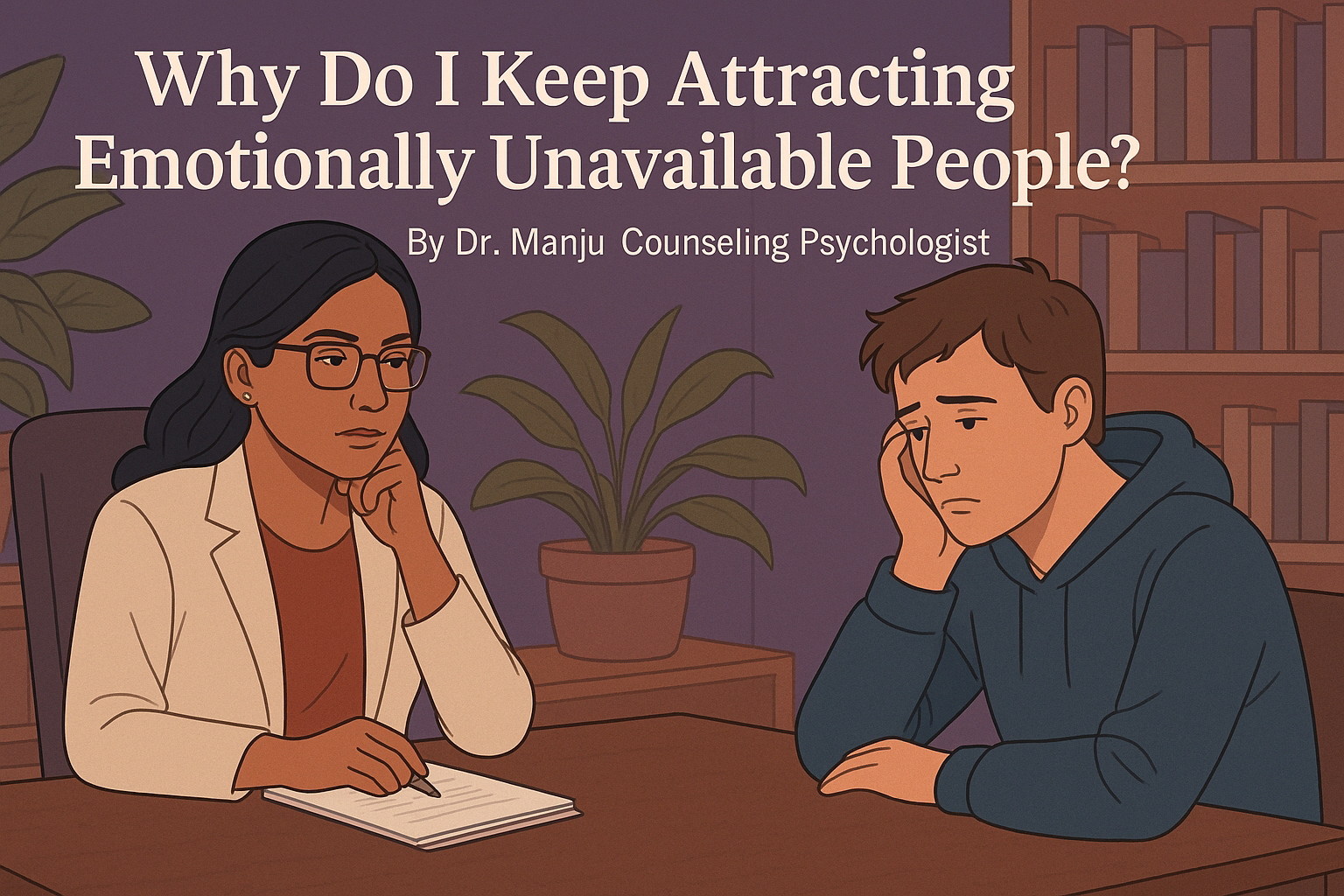
Why Do I Keep Attracting Emotionally Unavailable People?

Why Do I Keep Attracting Emotionally Unavailable People?”

By Dr. Manju Antil
Counseling Psychologist & Assistant Professor of Psychology


Hello dear reader,

Let’s talk about something many people carry quietly in their hearts: the pain of always ending up with someone who cannot meet you emotionally. You try, you wait, you hope. But somewhere deep down, a part of you knows—this isn’t the love you deserve.

If you’ve ever thought, “Why do I keep attracting people who can’t fully show up for me?”, know that you’re not alone. I’ve heard this question from clients, friends, and students alike. And it often hides another question beneath it: “Is there something wrong with me?”

Let me begin by gently saying this—there is nothing wrong with you. But there may be something wounded within you that keeps choosing what feels familiar over what feels healthy.

What Emotional Unavailability Looks Like

You might not always recognize it at first. In the beginning, they seem exciting, maybe even intense. They draw you in with charm or mystery. But slowly, you start noticing signs—commitment makes them uncomfortable, they avoid deeper conversations, or they pull away when things get emotionally intimate.

They may care about you. But care without emotional safety isn’t enough.

And that inconsistency—the highs and lows, the mixed signals—can start to feel like love when you're used to equating love with uncertainty.

Why Do We Get Drawn Into This Cycle?

In therapy, we often explore not just what is happening, but why. When people repeatedly find themselves in relationships with emotionally unavailable partners, it’s usually not a coincidence. It’s a pattern shaped by emotional history, past relationships, and unconscious beliefs about love.

For many, this starts in childhood. If your early caregivers were emotionally distant, inconsistent, or dismissive, you might have learned that love requires effort—that being loved means proving your worth. As adults, you may unconsciously seek the same dynamic, not because it makes you happy, but because it feels familiar.

Some people also carry a quiet belief that love must be earned through sacrifice. So, you give and give, waiting for the other person to finally see your value. But the truth is—love that demands you to shrink, wait, or suffer is not love. It's emotional survival.

When Love Feels Like Longing

There’s a difference between real connection and emotional hunger. But the hunger can feel intense—like longing, passion, or even chemistry. And that intensity can be mistaken for love, especially if you've never experienced love that feels safe and stable.

Emotionally unavailable partners often create a dynamic of waiting—waiting for clarity, waiting for consistency, waiting for change. But love should not feel like waiting. It should feel like being met, seen, and valued—now, not someday.

How to Break This Pattern

The first step is becoming aware of it. Patterns thrive in silence and repetition. Once you recognize the cycle, you begin to reclaim your power to choose differently.

The next step is reconnecting with your own emotional needs. Ask yourself: What does healthy love look like to me? What does safety feel like in a relationship? These aren’t abstract questions. They’re your new compass.

It also helps to reflect on your beliefs about yourself. Do you believe you're worthy of love that doesn't need to be earned? Can you accept love that feels calm, respectful, and emotionally consistent? If your nervous system is used to chaos, stability can feel unfamiliar. But unfamiliar doesn’t mean wrong.

Healing also means setting boundaries. You don’t need to fix someone to deserve their love. And you don’t have to abandon yourself to avoid being abandoned by someone else.

Lastly, give yourself permission to seek help. Therapy can offer a safe space to understand your emotional story and rewrite it. Sometimes, we need someone to help us see what we’ve been carrying for too long.

A Gentle Reminder

You are not too much. You are not asking for the impossible. You are not unworthy of love.

You are simply someone who wants to be loved with presence, with depth, and with honesty. And that’s a beautiful, human desire.

So if you’ve been choosing emotionally unavailable people, don’t shame yourself. Just notice it. Let that noticing be the beginning of a new way of loving—starting with how you love yourself.

The right love won’t confuse you. It won’t make you question your worth. It will feel like a soft landing after a long journey.

And you deserve that kind of love.

With warmth,
Dr. Manju Antil
Counseling Psychologist | Assistant Professor of Psychology


Share:

Soft Ghosting, Benching, and Breadcrumbing: Understanding Modern Dating Anxiety


Soft Ghosting, Benching, and Breadcrumbing: Understanding Modern Dating Anxiety

By Dr. Manju Rani, Counselling Psychologist & Assistant Professor

“He didn’t block me, but he just stopped replying.”
“She keeps watching my stories but never texts back.”
“We talk sometimes... but only when he feels like it.”

These are some of the most frequent lines I hear in counselling sessions with Gen Z clients navigating the emotional complexities of modern digital relationships.
Dating in the digital age is no longer just about compatibility or emotional connection—it now involves decoding vague signals, managing delayed responses, and confronting anxiety born out of partial engagement and unclear intentions.

In this article, I explore three emerging and psychologically distressing dating behaviours—soft ghosting, benching, and breadcrumbing—and how these patterns contribute to a rising tide of modern dating anxiety.

What Is Modern Dating Anxiety?

Modern dating anxiety refers to the ongoing stress, self-doubt, and emotional instability caused by ambiguous or inconsistent romantic interactions, often carried out over digital platforms. This form of anxiety is marked by:

  • A prolonged state of emotional uncertainty
  • Constant hypervigilance toward digital cues (such as blue ticks or story views)
  • A lack of closure or honest communication
  • Emotional exhaustion from unreciprocated emotional labour

1. Soft Ghosting

Definition: Soft ghosting occurs when someone stops responding to direct communication—such as messages or calls—while still maintaining passive interaction, like watching your Instagram stories or liking your posts.

Psychological Impact:

  • Creates emotional confusion and overthinking
  • Induces cycles of self-doubt and insecurity
  • Prevents emotional closure, prolonging attachment

Case Illustration: Ananya’s Experience
Ananya, a 21-year-old student, expressed her distress during therapy over a boy who stopped replying to her messages. However, he continued to watch all her social media updates.
“If he wanted to cut me off, why is he still looking at my life?” she asked.
Soft ghosting left her in an emotionally suspended state—neither rejected nor accepted—intensifying her anxiety.

2. Benching

Definition: Benching involves keeping someone as a "backup option" by maintaining occasional contact and interest but never committing to a relationship or deeper emotional engagement.

Psychological Impact:

  • Creates false hope and emotional dependency
  • Prevents individuals from moving on or forming meaningful connections
  • Erodes self-worth over time

Case Illustration: Ravi’s Delayed Realisation
Ravi, a 23-year-old professional, described how a woman he liked kept postponing meetings. She maintained friendly text exchanges but avoided any real interaction.
“I was just an option on her bench while she explored others,” he reflected.
The ambiguity of his situation delayed his healing and created unnecessary emotional strain.

3. Breadcrumbing

Definition: Breadcrumbing refers to the act of giving someone just enough attention or affection to keep them interested, without any genuine intent to pursue a relationship.

Psychological Impact:

  • Leads to emotional manipulation and confusion
  • Traps individuals in a cycle of anticipation and disappointment
  • Reinforces toxic relational patterns

Case Illustration: Meher’s Mixed Signals
Meher, aged 20, shared that the person she liked would occasionally send flirty messages and emojis late at night, only to disappear for days.
“Just when I decide to move on, he sends something sweet again,” she said.
This intermittent reinforcement made it difficult for her to detach emotionally.

Why Is This Prevalent Among Gen Z?

Several interrelated psychological and cultural factors contribute to the rise of such behaviours among Gen Z:

Factor Description
Abundance mentality Dating apps create the illusion of endless options, reducing the value of emotional investment.
Fear of direct rejection Many individuals avoid honest conversations, resorting instead to passive avoidance.
Emotional unavailability A lack of emotional literacy and relational maturity makes commitment difficult.
Digital intimacy Social media platforms blur boundaries between public performance and private connection.
Attachment insecurity Anxiously or avoidantly attached individuals are more vulnerable to relational instability.

Psychological Frameworks

  • Intermittent Reinforcement (Skinner, 1953): Breadcrumbing operates like a slot machine—unpredictable rewards make people invest more time and emotion, not less.
  • Attachment Theory (Bowlby, 1969): Individuals with anxious attachment are particularly susceptible to emotional manipulation, often justifying inconsistent behaviour as love.
  • Cognitive Dissonance (Festinger, 1957): Victims of soft ghosting or breadcrumbing often rationalise mistreatment to avoid acknowledging rejection.

Coping Strategies: Therapeutic Guidance

As a psychologist, I encourage individuals dealing with these dating patterns to prioritise their emotional clarity and autonomy. Here are some evidence-based strategies:

1. Acknowledge the Pattern
Recognising whether you are being ghosted, benched, or breadcrumbed helps restore self-trust and awareness.

2. Establish Digital Boundaries
Consider muting, unfollowing, or even blocking if passive digital contact is delaying your healing process.

3. Avoid Internalising Rejection
The behaviour of others—especially when immature or avoidant—does not define your self-worth.

4. Cultivate Emotional Resilience
Engage in activities that reinforce your identity outside of romantic validation—such as hobbies, professional growth, or therapy.

5. Seek Professional Support
Persistent emotional distress is a valid reason to speak with a mental health professional. Therapy offers a space to process unresolved feelings and learn healthier relational patterns.

Final Reflection

In a world where digital connections have blurred the lines between real and imagined intimacy, it is crucial to choose emotional clarity over confusion.
Do not allow yourself to become an option in someone else’s indecision. Healthy love is not ambiguous—it is consistent, mutual, and emotionally safe.

If you have experienced ghosting, benching, or breadcrumbing, remember: your pain is valid, and your healing is possible.

Stay Connected

For further insights on Gen Z psychology, digital behaviour, and relationship wellness, connect with me on the following platforms:

Authored by
Dr. Manju Rani
Psychologist | Assistant Professor | Mental Health Educator

Share:

Benching: When You’re Not Ghosted But Not Chosen Either| Dr. Manju Antil


Have you ever found yourself in a situation where someone keeps messaging you, seems interested, but never really commits? They give you just enough attention to make you stay, but not enough consistency to feel secure. This emotional tug-of-war is called benching, and it’s becoming increasingly common in today’s digital relationships.

As a counselling psychologist, I’ve seen countless individuals suffer silently in this emotionally confusing dynamic. This article is my way of helping you understand the psychological mechanisms, emotional consequences, and recovery tools around benching.

Whether you are currently being benched, have unknowingly benched someone, or are trying to support a friend through this, let’s explore this together with clinical clarity and compassion.

What Is Benching?

Benching is a term derived from sports. In a game, benched players are part of the team but are not playing—they sit on the sidelines waiting to be called in. Similarly, in relationships, benching happens when someone keeps you emotionally nearby without committing to a real relationship.

Key Characteristics of Benching:

  • They text you sporadically, often just when you start pulling away.

  • They flirt or express feelings but don’t follow through with plans.

  • They don’t introduce you to their close friends or family.

  • You are emotionally attached, but the relationship feels directionless.

Benching is not just poor communication—it is emotional ambiguity that creates psychological dependency.

Why Do People Bench Others? (Psychological Mechanisms)

Benching is not always intentional or malicious. It is often the result of unresolved psychological patterns and emotional insecurities. Let’s break this down:

1. Fear of Commitment:

Many people crave emotional connection but fear the vulnerability that comes with real commitment. They keep multiple emotional options open to avoid making a concrete choice.

2. Avoidant Attachment Style:

Individuals with avoidant attachment may appear emotionally available in short bursts but retreat when intimacy increases. They bench others to maintain control and emotional distance.

3. Validation Seeking:

Benching provides a steady stream of affirmation without the responsibilities of a relationship. The bencher feels desired, admired, and needed.

4. FOMO (Fear of Missing Out):

The person may enjoy your company but fear missing out on other potential partners. This leads to keeping you “on hold.”

5. Conflict Avoidance:

Instead of openly ending things, they avoid difficult conversations by keeping interactions vague. This indirect form of rejection is emotionally cruel.

“Benching is not about love—it’s about control without responsibility.”

What Does Being Benched Feel Like?

From my work with clients, I know that benching can feel like a slow emotional death. It leads to prolonged anxiety, rumination, and self-blame.

Emotional Symptoms:

  • Constant anticipation: “Will they text today?”

  • Second-guessing: “Did I say something wrong?”

  • Reduced self-esteem: “Why am I not good enough to be chosen?”

  • Emotional dependency: “I know they confuse me, but I can’t let go.”

The emotional inconsistency creates a feedback loop known as intermittent reinforcement—a well-known psychological concept where random rewards create powerful addiction-like attachment.

Case Study: Meera’s Story of Realization

Let me share the story of Meera, a confident, successful woman in her late 20s who came to therapy feeling emotionally drained. She had been chatting with Rishabh for over four months. He often texted her sweet messages like, “You’re the only one who understands me,” or “You’re special to me.”

But whenever she asked to meet or define the relationship, he would say, “Let’s not rush,” or “I’m not ready yet.”

Meera found herself checking her phone constantly, waiting for his messages, feeling elated when he replied, and spiraling into sadness when he ignored her.

Through therapy, Meera realized she was in a classic benching situation. She wasn’t confused—she was being confused. She gradually distanced herself from Rishabh, and with support, reclaimed her emotional clarity and confidence.

Benching in the Digital Era

Benching thrives in the digital landscape where emotional investment can happen without physical or social commitment.

Digital Benching Behaviours:

  • Reacting to your Instagram stories but not replying to your messages

  • Sending late-night texts like “Miss you” without real follow-up

  • Tagging you in memes instead of making real plans

  • Sharing cryptic quotes about “soul connections” without action

These digital gestures create illusions of affection and connection. They are emotionally stimulating but hollow.

“In a world of emojis and likes, real love still needs clarity and action.”

Psychological Effects of Benching

As a psychologist, I emphasize that the emotional toll of benching is often underestimated. It leads to real psychological consequences.

Common Mental Health Impacts:

  • Generalized Anxiety Disorder: Persistent worrying about the relationship status.

  • Attachment Insecurity: Fear of abandonment and rejection.

  • Sleep Disturbances: Due to overthinking and emotional dysregulation.

  • Emotional Burnout: Chronic emotional exhaustion and withdrawal.

  • Identity Confusion: Difficulty trusting one’s own feelings and instincts.

How to Know If You’re Being Benched

Ask yourself the following diagnostic questions:

✅ Do I feel consistently valued in this connection?
✅ Are my emotional needs being met—or just delayed?
✅ Does the person follow through on what they say?
✅ Do I feel anxious, confused, or disrespected more than reassured?
✅ Am I the only one investing in this emotional connection?

If most answers lean toward emotional inconsistency, you are likely being benched.

What You Can Do (Practical Advice)

Here are therapeutic strategies I often suggest to clients in these situations:

1. Communicate Directly

Say something like: “I care about you, but I need clarity. Are you interested in building something real?”

2. Set Emotional Boundaries

Decide how much time, energy, and emotion you are willing to invest without reciprocity.

3. Observe Patterns, Not Promises

Don’t be swayed by charming words. Look at actions. Are they consistent, available, and respectful?

4. Rebuild Your Emotional Self-Worth

Spend time nurturing your own emotional needs through journaling, therapy, and meaningful social connections.

5. Let Go With Dignity

It’s okay to walk away from someone who leaves you confused. You deserve a relationship that doesn’t require decoding.

To Those Who Bench Others

If you recognize that you’ve benched someone, reflect deeply. Are you using their emotions as a cushion for your loneliness? Are you afraid of confronting your own indecision?

It’s okay to not be ready for a relationship. But it’s not okay to manipulate someone’s feelings just to keep them around.

Be honest. Be kind. Be accountable.

Final Words from Dr. Manju Antil

Benching is not soft rejection—it is emotional abandonment disguised as affection.

Love should feel like safety, not suspense. Relationships require emotional clarity, mutual respect, and consistent communication. Anything less is emotional limbo.

“If you’re wondering where you stand with someone, step away until you’re sure of your own worth.”

You deserve:

  • To be prioritized

  • To be emotionally respected

  • To be someone’s choice—not their backup

Closing Message

If you’re stuck in a benched relationship, I see you. If you’ve been confused by someone’s mixed signals, your feelings are valid. It’s time to step off the emotional sidelines and take the lead in your own healing.

🌐 Visit: www.psychologistmanjuantil.com
📸 Instagram: @wellnessneti_care
🎙 YouTube: Dr. Manju Rani |Wellnessnetic Care

Share:

What is Affair Fog? Why It Feels So Magical—Until It Isn’t


 "I never meant to fall for them... but I couldn’t help it."

If this sounds familiar, you’re not alone. It’s a line I often hear in therapy from people who never thought they’d find themselves caught in the emotional web of an affair.

This is not about villains and victims. It’s about a powerful psychological experience that clouds judgment, rewrites history, and often leads to regret. This is Affair Fog — and it’s far more common, especially in the digital age.

Let’s explore the neuroscience, psychology, and real-life implications of affair fog — and how to find clarity on the other side.

What Is Affair Fog?

Affair Fog is a temporary psychological condition that occurs when someone becomes emotionally or physically involved in a relationship outside their primary commitment. It results in cognitive dissonance, emotional confusion, moral detachment, and a distorted perception of reality.

In this state, people:

  • Idealize the affair partner and diminish their flaws
  • Experience withdrawal or criticism toward their current partner
  • Justify or minimize deceitful behaviors
  • Believe that the new relationship represents their true happiness

It feels like clarity, but it’s a mirage. Like fog over a highway, it distorts your vision just enough to make you lose your direction.

The Brain Chemistry Behind the High

Affair fog isn't just emotional — it's neurochemical. When you're in the early stages of romantic or sexual excitement, your brain releases a rush of chemicals:

  • Dopamine: fuels excitement, euphoria, and anticipation. You crave more.
  • Oxytocin: creates bonding and the illusion of deep emotional intimacy
  • Adrenaline: intensifies thrill and urgency, especially in secrecy
  • Serotonin dips: result in obsessive thoughts and emotional restlessness

These chemicals create a neurological feedback loop, making the affair feel intensely rewarding—even if it contradicts your values.

The Psychology of Denial, Projection, and Fantasy

The fog thickens due to psychological defenses. When your actions contradict your core beliefs, the mind often turns to:

  • Denial: "I didn't plan this, it just happened."
  • Projection: "My partner never supported me. This new person gets me."
  • Rationalization: "We were drifting apart anyway."
  • Fantasy formation: "This is true love. It must mean something."

These defenses protect your ego but distort the emotional truth. You build a narrative that justifies emotional betrayal while numbing the cognitive dissonance.

Emotional Affairs Count Too

Many Gen Z and millennials fall into emotional affairs without realizing it. These often look like:

  • Late-night texting with someone you confide in more than your partner
  • Emotional dependency masked as friendship
  • Hiding conversations or downplaying their importance
  • Daydreaming about a future with someone else

Remember: It’s not the label that defines an affair, it’s the secrecy and emotional shift.

Why Gen Z Is Especially Vulnerable

Your generation is facing:

  • Swipe Culture: constant exposure to new options
  • Situationships: blurred lines and undefined emotional boundaries
  • Instant Gratification: seeking quick highs over long-term emotional work
  • Emotional Burnout: navigating relationships while healing from trauma or mental fatigue
  • Validation Loops: from social media, dating apps, and online praise

Affair fog offers momentary escape from reality—but often at the cost of emotional maturity and future relational health.

The Hidden Impact on the Betrayed Partner

Affair fog isn't just dangerous for the one inside it. The betrayed partner often suffers silently, experiencing:

  • Intense psychological confusion and grief
  • Sleep disturbances and rumination
  • Loss of trust, self-worth, and emotional security
  • Trauma symptoms that may mimic PTSD

This emotional damage deepens when the involved partner is still in the fog, unable or unwilling to see the pain they’re causing.

Signs You’re in Affair Fog

You might be in affair fog if:

  • You feel more emotionally connected to someone other than your partner
  • You justify emotional or physical secrecy with ease
  • You minimize the consequences of your actions
  • You’re addicted to the thrill despite knowing it’s not sustainable
  • You feel emotionally distant, numb, or resentful toward your partner

The Fog Is Digital Too

Modern-day affairs are often tech-fueled. Even if you're miles apart, emotional intimacy can thrive through:

  • Social media DMs: secrecy intensifies emotional bonding
  • Voice notes and inside jokes: simulate closeness
  • Deleted conversations: concealment builds fantasy
  • Curated photos and stories: selective self-presentation fuels idealization

These digital touchpoints sustain the fog and make it harder to separate fantasy from reality.

How to Come Out of the Fog

1. Cut Emotional and Physical Contact

This is non-negotiable. Without distance, clarity is impossible.

2. Interrupt the Fantasy

Name it for what it was: not love, but longing + illusion + neurochemical craving.

3. Own the Emotional Impact

Apologize not just for the affair, but for the emotional withdrawal, gaslighting, and deception.

4. Start Individual Therapy

Explore your unmet needs, attachment wounds, identity confusion, and emotional regulation patterns.

5. Rebuild Personal Integrity

Whether or not your relationship survives, rebuild yourself as someone who lives and loves with emotional accountability.

Final Thoughts: The Fog Can Lift

Affair fog isn't your enemy. It's a wake-up call. It signals that something within you needs reflection, healing, and realignment.

If you're in the fog: you’re not evil, weak, or broken. But you are responsible. If you’re hurt by someone in the fog: you deserve truth, clarity, and deep healing.

The affair isn’t the real story. The real story begins when you decide to face yourself with honesty.

Healing begins where fantasy ends.

 About the Author

Dr. Manju Rani Antil is a psychologist, and  Assistant Professor at Apeejay Stya University, and founder of Wellnessnetic Care. She specializes in projective and psychometric assessment, relationship psychology, and emotional wellness in the digital age. With over a decade of teaching, counselling, and research experience, she brings empathy, insight, and evidence-based approaches to every topic she writes and speaks on.

For therapy, speaking invitations, or collaborations:

Share:

Understand why affairs feel magical—but end in confusion, regret, and trauma| Affair Fog is Real — And It’s Hijacking Your Mind

Affair fog is a term increasingly used in clinical psychology and relationship therapy to describe a psychological condition in which individuals involved in an extramarital or extradyadic relationship experience emotional confusion, cognitive dissonance, and a distorted perception of reality. This “fog” not only alters the way they view their current relationship and partner but also idealizes the affair partner to the point of denying logic, empathy, and prior emotional truths.

It is not merely a metaphor—it is a deeply rooted psychological response arising from intense emotional arousal, neurochemical changes, unmet relational needs, and often, unresolved trauma or identity confusion. The result? A person swept away in a fantasy-driven narrative that disrupts personal values, long-standing commitments, and emotional clarity.

This phenomenon, though painful, is not irreversible. With the right insight and therapeutic understanding, the fog can be cleared—and that’s what this blog aims to unpack.

Explaining Affair Fog: A Clinical Perspective by Dr. Manju Antil

I am Dr. Manju  Antil, a Assistant Professor at Apeejay Stya University, and founder of Wellnessnetic Care. With over a decade of experience in projective and psychometric assessments, mental health advocacy, and therapeutic practice, I have worked extensively with individuals navigating emotional trauma, complex relationships, and digital-age distress patterns.

Through this blog, I will break down the concept of affair fog—from its psychological and neurobiological foundations to its real-world impact—and provide forward-thinking strategies for healing, whether you're the one in the fog or the one hurt by it.

Let’s begin.

What Is Affair Fog?

Affair fog is a temporary state of emotional and cognitive distortion that occurs when a person becomes emotionally or physically involved in a secondary relationship while still attached to a primary one.

In this state, individuals often:

  • Idealize the affair partner as “the one” or a “soulmate”
  • Devalue or rewrite the history of their primary relationship
  • Justify secrecy and betrayal by minimizing the impact
  • Withdraw empathy from their current partner
  • Confuse intensity with intimacy

The affair often feels like an escape from dissatisfaction or emotional neglect, but in reality, it becomes a psychological trap—a foggy terrain where the person loses their ethical bearings, emotional depth, and relational context.

The Neuroscience Behind the Fog

From a neurobiological viewpoint, affair fog mimics the early phases of romantic love or even addictive behavior. Here's how:

  • Dopamine – Reinforces the pleasure-reward cycle, causing a “high” during secret interactions.
  • Oxytocin – Creates false intimacy and bonding, even in emotionally superficial affairs.
  • Adrenaline – Heightens the thrill factor, making the affair seem urgent and extraordinary.

These neurochemicals hijack the brain's reasoning systems, leading to poor decision-making, impulsive behaviors, and emotional rationalization.

Psychological Defense Mechanisms in Action

Affair fog is sustained by a set of unconscious defense mechanisms:

  • Denial – Refusing to acknowledge the harm caused
  • Projection – Blaming the primary partner for personal dissatisfaction
  • Minimization – Downplaying the seriousness of the affair
  • Fantasy formation – Building an idealized story about the affair partner and future

These defenses offer temporary emotional relief but prevent genuine self-awareness and relationship repair.

The Impact on the Betrayed Partner

While the involved partner is lost in the fog, the betrayed partner often experiences emotional trauma akin to post-traumatic stress. Their world is disrupted without closure, and they may experience:

  • Emotional invalidation and gaslighting
  • Loss of identity, trust, and psychological safety
  • Obsessive rumination and self-blame
  • Relationship grief—even when the relationship continues

Often, the pain is intensified when the involved partner remains emotionally absent or confused due to the fog.

Modern Manifestations: The Digital Age of Affair Fog

Affair fog is no longer limited to physical infidelity. In today’s hyperconnected world, many affairs are:

  • Emotional – Involving deep connection via messages, calls, or online interactions
  • Virtual – Maintained through social media DMs, late-night texts, and secret accounts
  • Ambiguous – Occurring within “situationships” or undefined commitments

This makes emotional boundaries harder to define, especially for Gen Z and millennials, who often struggle to distinguish emotional intimacy from ethical commitment.

How to Clear the Fog: A Step-by-Step Path

Clearing affair fog requires courage, insight, and professional support. Here’s how the process begins:

1. Cut Emotional Ties with the Affair Partner

Without emotional distance, the fog cannot lift.

2. Seek Individual Therapy

Understand why the affair occurred—emotionally, relationally, and psychologically.

3. Practice Radical Self-Honesty

Challenge the fantasy and re-evaluate the facts of your relationship.

4. Acknowledge the Harm Done

Take full accountability, not just for your actions, but for the emotional consequences they caused.

5. Work Towards Clarity—Not Just Closure

Whether or not the relationship survives, seek emotional clarity and self-integration.

 Closing Thoughts: From Fog to Freedom

Affair fog is not a sign of evil or weakness. It is a symptom of emotional confusion, often stemming from unresolved wounds, unmet needs, and identity diffusion. But like all symptoms, it can be healed with insight, therapy, and intention.

As a psychologist, I do not shame individuals for being in the fog—but I do hold space for accountability, clarity, and relational maturity.

You can clear the fog.
You can reconnect with your values.
You can build or rebuild relationships grounded in truth.


If you found this article helpful or insightful, feel free to share it with someone who may be navigating emotional confusion in their relationship. For therapy inquiries, speaking engagements, or mental health consultations, visit me at www.psychologistmanjuantil.com.


Share:

Delusionships and the Psychology of Imagined Intimacy in the Digital Age| The Psychological Fallout of One-Sided Attachments in the Age of Hyperconnectivity

"Delusionship" is an emerging term that blends delusion and relationship, typically describing a one-sided or imagined romantic involvement with little or no reciprocation. This phenomenon has gained traction among Generation Z, influenced heavily by curated digital realities, parasocial interactions, and heightened emotional vulnerabilities. This article explores delusionships from a psychological perspective, integrating attachment theory, cognitive distortions, and social media psychology. It offers illustrative case studies and therapeutic insights to examine the emotional toll and behavioral implications of delusionships, while suggesting culturally relevant interventions for the digital age.

Introduction

Delusionships are romantic or emotional attachments that exist primarily in an individual's mind, often without substantial mutual interaction or acknowledgment from the other party. Popularized through TikTok and Gen Z lexicons, the term reflects a cultural shift in how relationships are perceived and pursued in a hyperconnected era (Sharma, 2023). Unlike typical unrequited love, delusionships are marked by over-identification, imagined intimacy, and cognitive distortions that inflate the perceived relationship’s depth.

These delusions may seem benign but often mask underlying emotional vulnerabilities such as loneliness, fear of rejection, or unresolved attachment wounds. As digital connectivity increases, the line between emotional reality and fantasy continues to blur, making delusionships not just a pop-culture buzzword but a psychological phenomenon worthy of academic exploration.

Theoretical Foundations

Attachment Theory

According to Bowlby’s (1969) attachment theory, early attachment patterns shape our relational templates. Anxious attachment styles are particularly susceptible to delusionships, as such individuals often seek closeness, validation, and romantic attention—even in the absence of reciprocation (Mikulincer & Shaver, 2007).

Parasocial Relationships

First coined by Horton and Wohl (1956), parasocial relationships describe one-sided emotional bonds formed with media figures. In the age of influencers, even non-celebrity interactions on Instagram or WhatsApp can become parasocial, especially when users misinterpret digital cues as genuine intimacy (Giles, 2002).

Fantasy-Prone Personality and Projection

People high in fantasy proneness and neuroticism are more likely to engage in imagined romantic scripts. They project their desires onto another person, who often remains unaware or emotionally unavailable. Such projections can mirror psychodynamic concepts of transference, where unmet childhood needs are projected onto adult targets (Freud, 1912).

Triggers of Delusionships

  1. Digital Proximity: Constant visibility via stories, likes, and online presence creates an illusion of intimacy.

  2. Loneliness and Social Isolation: Studies have shown that loneliness increases susceptibility to romantic idealization (Cacioppo & Patrick, 2008).

  3. Cultural Idealization of Love: Media portrayals often romanticize persistence and fantasy over communication and consent.

  4. Attachment Insecurity: Those with insecure attachment may seek love in unavailable places, leading to fantasy-based attachments.

Case Studies

Case Study 1: The Imagined Relationship with a Co-Worker

Subject: Riya, 26, Marketing Executive, New Delhi

Narrative: Riya developed a strong emotional attachment to a colleague, Arjun. They occasionally exchanged pleasantries, but Riya interpreted his friendliness as flirtation. Over time, she started daydreaming about their future, feeling hurt when Arjun didn’t ask her out or engage further. She even avoided dating others, convinced he was just waiting for the right moment.

Analysis: Riya exhibited signs of cognitive distortion (selective abstraction and personalization). Her anxious attachment style likely fueled her need for emotional validation through imagined closeness. When Arjun announced his engagement to someone else, Riya experienced symptoms of grief similar to a breakup, despite never having dated him.

Therapeutic Insight: CBT helped Riya identify maladaptive thought patterns and distinguish reality from fantasy. Mindfulness practices aided in emotional regulation.

Case Study 2: The Influencer Obsession

Subject: Armaan, 21, College Student, Mumbai

Narrative: Armaan followed a popular fitness influencer, feeling a deep emotional connection to her posts, stories, and captions. He believed her "motivational quotes" were directed at him. He imagined conversations and even began turning down real-life dating opportunities. When she got married and posted wedding pictures, Armaan experienced intense sadness and insomnia.

Analysis: This delusionship mirrors a parasocial relationship escalated by emotional projection. Armaan’s underlying social anxiety made virtual affection feel safer than real-world intimacy.

Therapeutic Insight: Psychodynamic therapy explored unresolved maternal attachment issues. Gradual exposure to offline social settings helped rebuild real-world relational competence.

Delusionship vs. Healthy Crush

A healthy crush involves admiration and desire but maintains awareness of boundaries and reality. In contrast, delusionships involve:

  • Emotional investment without reciprocation

  • Rewriting interactions to fit a romantic narrative

  • Avoidance of real relationships

Clinically, delusionships can border on limerence—an obsessive state of infatuation marked by intrusive thoughts and fantasies (Tennov, 1979).

Consequences of Delusionships

  • Emotional Burnout: Constant overthinking and fantasizing can lead to fatigue, sadness, and emotional depletion.

  • Self-Esteem Issues: Repeated emotional rejection (real or perceived) reinforces inadequacy.

  • Social Withdrawal: Individuals may avoid real-world interactions or dating opportunities.

  • Mood Disturbances: Anxiety, depression, and insomnia may result from unmet emotional expectations (APA, 2022).

Role of Social Media

Social platforms create a psychological echo chamber that rewards obsession with constant dopamine hits—likes, comments, seen receipts. Algorithms reinforce attention-seeking and illusion of closeness (Andreassen et al., 2012).

Apps like Instagram foster “micro-intimacy,” where stories, reactions, and mutual follows simulate emotional proximity. Gen Z’s preference for text-based flirting amplifies ambiguity, making it easier to misinterpret friendliness as romantic interest.

Therapeutic Interventions

1. Cognitive Behavioral Therapy (CBT)

  • Identify and restructure distorted thoughts

  • Reality testing techniques (journaling, cognitive maps)

2. Psychodynamic Psychotherapy

  • Explore unresolved needs and projection origins

  • Understand internalized love scripts

3. Mindfulness-Based Interventions

  • Grounding practices to stay present

  • Observe thoughts without attachment

4. Digital Detox and Boundaries

  • Reduce exposure to triggering content

  • Practice intentional online behavior

5. Group Therapy and Psychoeducation

  • Normalize experiences through group sharing

  • Educate about healthy relational frameworks

Conclusion and Future Directions

Delusionships represent a growing psychological pattern in the digitally native population, especially among Gen Z. Though they may appear harmless, these one-sided fantasies can significantly impair emotional functioning and delay healthy relational growth. As the lines between digital and physical spaces continue to blur, psychologists, educators, and content creators must collaboratively promote emotional literacy and healthy relational boundaries.

Future research should investigate cultural differences in delusionship formation, neurobiological correlates of fantasy-prone personalities, and long-term impact on relational development. Additionally, AI and virtual relationships may usher in newer forms of delusionships that require novel ethical and clinical frameworks.

References

  • American Psychological Association. (2022). Diagnostic and Statistical Manual of Mental Disorders (5th ed., text rev.; DSM–5–TR).

  • Andreassen, C. S., Torsheim, T., Brunborg, G. S., & Pallesen, S. (2012). Development of a Facebook Addiction Scale. Psychological Reports, 110(2), 501–517.

  • Bowlby, J. (1969). Attachment and Loss: Vol. 1. Attachment. New York: Basic Books.

  • Cacioppo, J. T., & Patrick, W. (2008). Loneliness: Human Nature and the Need for Social Connection. W. W. Norton & Company.

  • Freud, S. (1912). The dynamics of transference. Collected Papers, Vol. II.

  • Giles, D. C. (2002). Parasocial Interaction: A Review of the Literature and a Model for Future Research. Media Psychology, 4(3), 279–305.

  • Horton, D., & Wohl, R. R. (1956). Mass Communication and Para-Social Interaction. Psychiatry, 19(3), 215–229.

  • Mikulincer, M., & Shaver, P. R. (2007). Attachment in adulthood: Structure, dynamics, and change. Guilford Press.

  • Sharma, P. (2023). The Rise of Delusionships: Why Gen Z Is Falling in Love with Fantasies. Youth & Media Journal, 5(2), 45–53.

  • Tennov, D. (1979). Love and Limerence: The Experience of Being in Love. Scarborough House.


Share:

Introduction to Relationship Churning| Relationship Churning


In the ever-evolving landscape of modern relationships, the term "relationship churning" has gained significant attention. Relationship churning refers to the repetitive cycle of breaking up and getting back together with the same partner. This pattern can lead to emotional turmoil and instability, affecting both individuals and the relationship as a whole. This article delves into the intricacies of relationship churning, examining its causes, impacts, and strategies to break free from this detrimental cycle.

Understanding Relationship Churning

To grasp the concept of relationship churning, it’s essential to explore its key elements and historical context. Relationship churning isn't a new phenomenon; it has been observed throughout history, albeit under different names. Modern implications, however, have amplified its prevalence due to changing societal norms and technological advancements.

The Psychology Behind Relationship Churning

The psychology of relationship churning is deeply rooted in attachment styles and emotional triggers. Individuals with insecure attachment styles are more prone to engage in relationship churning. Cognitive dissonance also plays a role, as individuals struggle to reconcile their conflicting emotions about the relationship.

Common Patterns in Relationship Churning

Patterns of breakup and make-up cycles are characteristic of relationship churning. These cycles often involve emotional highs and lows, creating an emotional roller coaster for those involved. Behavioral patterns such as impulsive decisions and unresolved conflicts contribute to this repetitive cycle.

Causes of Relationship Churning

Several factors contribute to relationship churning. Lack of effective communication is a primary cause, leading to misunderstandings and unresolved issues. Insecurity, whether due to personal self-esteem issues or perceived threats to the relationship, also plays a significant role. External influences, such as societal pressure and opinions from friends and family, can exacerbate the cycle.

Impact of Relationship Churning on Individuals

The emotional toll of relationship churning on individuals is profound. Frequent breakups and reconciliations can lead to emotional exhaustion, affecting mental health and overall well-being. Self-esteem often suffers, as individuals may internalize the instability as a personal failure.

 Impact of Relationship Churning on Relationships

For the relationship itself, churning can create deep-seated trust issues and undermine stability. Long-term consequences include a decreased likelihood of a healthy, lasting relationship, as the cycle of instability erodes the foundation of trust and mutual respect.

Signs of Relationship Churning

Recognizing the signs of relationship churning is crucial for addressing the issue. Frequent breakups, constant arguments, and an on-and-off relationship status are clear indicators. Understanding these signs can help individuals and couples identify the problem and seek solutions.

The Role of Social Media in Relationship Churning

Social media has a significant impact on relationship dynamics, including relationship churning. Digital footprints, such as old photos and posts, can trigger emotional responses and influence decisions. The pressure to maintain a certain image online also contributes to relationship instability.

How to Break the Cycle of Relationship Churning

Breaking the cycle of relationship churning requires self-awareness and effective communication. Individuals must recognize their patterns and triggers, and couples should engage in open, honest conversations about their feelings and concerns. Seeking therapy and counseling can provide the tools and support needed to break free from the cycle.

Strategies for Healthy Relationship Dynamics

Building a healthy relationship involves developing trust, emotional intelligence, and conflict resolution skills. Trust is the cornerstone of any stable relationship, while emotional intelligence allows partners to navigate their emotions and respond empathetically. Effective conflict resolution ensures that disagreements are addressed constructively, preventing them from escalating into larger issues.

 The Role of Friends and Family in Relationship Churning

Friends and family play a significant role in relationship dynamics. Their opinions and support can influence decisions and behaviors. While their insights can be valuable, it's essential for individuals to differentiate between helpful advice and undue pressure.

Case Studies of Relationship Churning

Examining real-life examples of relationship churning provides valuable insights. Case studies highlight the patterns and consequences of churning, offering lessons on what works and what doesn't. Psychological analysis of these cases can shed light on underlying issues and effective interventions.

Therapeutic Approaches to Address Relationship Churning

Therapeutic interventions such as Cognitive Behavioral Therapy (CBT) and couple's counseling can be effective in addressing relationship churning. These approaches help individuals and couples understand their behaviors, develop healthier coping mechanisms, and improve their communication skills.

 Preventing Relationship Churning

Prevention is key to avoiding the detrimental effects of relationship churning. Recognizing early warning signs and taking proactive measures, such as relationship education and regular check-ins, can help maintain a healthy relationship dynamic.

Rebuilding After Relationship Churning

Rebuilding a relationship after experiencing churning involves a healing process for both individuals. Re-establishing trust is crucial, and couples must commit to addressing the underlying issues that led to the cycle. Moving forward requires a mutual effort to create a stable, supportive environment.

 The Future of Relationship Churning

As societal norms and technology continue to evolve, the dynamics of relationship churning may also change. Trends and predictions suggest that awareness and education will play a vital role in reducing the prevalence of churning. Understanding and adapting to these changes can help individuals and couples navigate their relationships more effectively.

Expert Opinions on Relationship Churning

Experts in psychology and relationship counseling offer valuable insights into relationship churning. Their research and observations provide a deeper understanding of the phenomenon and suggest effective strategies for managing and overcoming it.

Frequently Asked Questions about Relationship Churning

What is relationship churning?

Relationship churning refers to the cycle of breaking up and getting back together with the same partner repeatedly.

Why do people engage in relationship churning?

Various factors, including attachment styles, emotional triggers, and external influences, contribute to relationship churning.

How can relationship churning affect mental health?

Relationship churning can lead to emotional exhaustion, anxiety, and depression, impacting overall mental well-being.

Can therapy help with relationship churning?

Yes, therapy can provide tools and support to help individuals and couples break the cycle and develop healthier relationship patterns.

What are the signs of relationship churning?

Frequent breakups, constant arguments, and an on-and-off relationship status are common signs of relationship churning.

How can couples prevent relationship churning?

Effective communication, trust-building, and recognizing early warning signs are essential strategies to prevent relationship churning.

Conclusion on Relationship Churning

In conclusion, relationship churning is a complex phenomenon that affects many modern relationships. Understanding its causes and impacts is crucial for addressing the issue and fostering healthier connections. By breaking the cycle of churning through self-awareness, communication, and professional support, individuals and couples can build more stable and fulfilling relationships.

Share:

Unveiling the Mysteries of Twin Flames: 7 Signs and Stages Explained| Dr Manju Rani


The concept of twin flames has intrigued spiritual seekers and romantics alike. These relationships are often perceived as the most intense and transformative connections one can experience. But what exactly are twin flames, and how do they differ from soulmates? This article aims to demystify twin flames by exploring their signs, stages, and the challenges they present.

What is a Twin Flame?

Definition and Concept

A twin flame is believed to be a person's other half, a mirror soul created from the same source. This connection is profound and spiritual, transcending physical attraction and emotional bonds. Twin flames often feel an immediate, inexplicable connection, as if they have known each other for lifetimes.

Origins and Historical Background

The concept of twin flames dates back to ancient times, rooted in various spiritual and philosophical traditions. Plato’s "Symposium" discusses the idea of a single soul split into two bodies, searching for its other half. This notion has persisted through the ages, appearing in different forms in various cultures and belief systems.

Twin Flames vs. Soulmates

Key Differences

While both twin flames and soulmates represent deep connections, they are fundamentally different. A soulmate is a person with whom one shares a profound, often comfortable relationship, usually aimed at personal growth and life lessons. In contrast, a twin flame relationship is intense and challenging, pushing both individuals toward spiritual awakening and self-realization.

Unique Characteristics of Each

Soulmate relationships are typically harmonious, characterized by mutual respect and understanding. Twin flame relationships, however, are marked by their intensity and the profound transformation they bring. Twin flames often challenge each other, reflecting each other’s strengths and weaknesses, and catalyzing significant personal growth.

The Signs of a Twin Flame

Deep Connection and Instant Recognition

One of the most telling signs of a twin flame connection is an immediate, deep bond upon meeting. Twin flames often feel a sense of recognition, as if they have known each other forever, despite having just met.

Intense Emotions

The emotional intensity in a twin flame relationship is unparalleled. This connection can evoke the highest highs and the lowest lows, pushing both individuals to confront their deepest fears and desires.

Spiritual Awakening

Meeting a twin flame often triggers a profound spiritual awakening. This can lead to a heightened sense of purpose, a deeper understanding of oneself, and a more meaningful approach to life.

Mirroring and Growth

Twin flames act as mirrors, reflecting each other’s innermost thoughts, feelings, and insecurities. This mirroring effect can be both challenging and transformative, fostering significant personal growth and self-awareness.

Synchronicities and Unexplained Coincidences

Twin flames often experience synchronicities and coincidences that defy logical explanation. These can include repeated number patterns, similar life experiences, and seemingly random events that hold deep significance.

Telepathic Communication

Many twin flames report a form of telepathic communication, where they can sense each other’s thoughts and emotions, even when physically apart. This deep psychic bond reinforces the sense of unity and connection between them.

Unconditional Love

The love shared between twin flames is unconditional and transcendent. Despite the challenges and obstacles, this love remains unwavering, providing a strong foundation for their spiritual journey together.

The Stages of a Twin Flame Journey

Recognition and Awakening

The journey begins with recognition and an awakening, where both individuals become aware of their profound connection. This stage is often marked by intense emotions and a deep sense of purpose.

The Crisis

As the relationship progresses, a crisis stage often arises, challenging both individuals to confront their fears, insecurities, and unresolved issues. This stage is crucial for personal growth and spiritual development.

The Runner and Chaser Phase

The runner and chaser phase is a common dynamic in twin flame relationships. One person may retreat (the runner) due to the intensity of the connection, while the other pursues (the chaser), seeking to resolve the issues and reunite.

The Surrender and Dissolution

In this stage, both individuals learn to surrender their egos and release the need to control the relationship. This dissolution of old patterns allows for healing and a deeper understanding of their connection.

Harmonization

The final stage is harmonization, where both individuals come into alignment with each other and their shared purpose. This stage represents a balanced, harmonious union, marked by mutual respect and unconditional love.

Challenges in a Twin Flame Relationship

Emotional Turmoil

The intense emotions and deep connection in a twin flame relationship can lead to significant emotional turmoil. This can manifest as anxiety, fear, and emotional upheaval, challenging both individuals to navigate their feelings.

Personal Growth and Healing

Twin flame relationships often necessitate personal growth and healing. Both individuals must confront and heal their past traumas, fears, and insecurities to achieve a harmonious union.

External Obstacles

External obstacles, such as societal expectations, geographical distance, and personal circumstances, can further complicate the twin flame journey. Overcoming these challenges requires resilience, patience, and a strong commitment to the relationship.

How to Navigate a Twin Flame Relationship

Self-Reflection and Inner Work

Self-reflection and inner work are essential in navigating a twin flame relationship. Both individuals must engage in introspection, addressing their inner wounds and fostering personal growth.

Effective Communication

Clear and honest communication is crucial in a twin flame relationship. Open dialogue about feelings, fears, and expectations can help both individuals understand each other better and strengthen their bond.

Seeking Spiritual Guidance

Seeking spiritual guidance from mentors, counselors, or spiritual practitioners can provide valuable insights and support in navigating the complexities of a twin flame relationship.

Common Myths About Twin Flames

Misconceptions

There are many misconceptions about twin flames, such as the belief that they are always romantic partners or that the relationship is meant to be perfect. In reality, twin flame relationships can take various forms and are often fraught with challenges.

The Reality of Twin Flame Dynamics

Understanding the reality of twin flame dynamics is essential. These relationships are not always easy, but they offer profound opportunities for spiritual growth and self-discovery.

The Role of Astrology in Twin Flames

Birth Charts and Compatibility

Astrology can offer insights into twin flame relationships, with birth charts revealing compatibility and potential challenges. Understanding astrological influences can help twin flames navigate their journey with greater awareness.

Astrological Signs

Certain astrological signs may have a stronger propensity for twin flame connections. Exploring the astrological compatibility of twin flames can provide deeper insights into their relationship dynamics.

Twin Flames in Popular Culture

Books and Movies

Twin flames have been depicted in numerous books and movies, often romanticizing the intense connection and the challenges involved. These portrayals can offer both inspiration and unrealistic expectations.

Influential Figures

Many influential figures in history and contemporary culture have been believed to experience twin flame relationships, adding to the intrigue and fascination surrounding this concept.

FAQs

What is the difference between a twin flame and a soulmate?

Twin flames are often seen as one's other half, a mirror soul created from the same source, while soulmates are individuals who share a deep, harmonious connection aimed at personal growth and life lessons.

How can I recognize my twin flame?

Recognition of a twin flame often comes with an immediate, deep connection, intense emotions, spiritual awakening, and various synchronicities.

Are twin flame relationships always romantic?

No, twin flame relationships can take various forms, including friendships and familial bonds. The connection is more about spiritual growth than romantic involvement.

What is the runner and chaser phase in a twin flame relationship?

This phase involves one partner retreating due to the intensity of the connection (the runner

Share:

Love Bombing: A Comprehensive Guide to Understanding, Recognizing, and Responding to Emotional Manipulation| Dr Manju Rani


Love bombing is a manipulative tactic characterized by excessive attention, flattery, and affection with the intent to influence and control another person. Often employed in the early stages of a relationship, love bombing can feel overwhelmingly positive and flattering, masking underlying manipulative intentions. Understanding this phenomenon is crucial for identifying and protecting oneself from emotional abuse.

Understanding Love Bombing

Psychologists define love bombing as a form of emotional manipulation where the perpetrator showers their target with grand gestures of affection and attention to gain control. This behavior can create a powerful emotional bond that is difficult for the victim to break, often leading to dependency and vulnerability.

History and Evolution of Love Bombing

The term "love bombing" was first coined by members of the Unification Church in the 1970s to describe their practice of overwhelming new recruits with attention and affection to secure their loyalty. Since then, the concept has evolved and is now recognized as a common tactic used by narcissists and abusers in various types of relationships.

Signs and Symptoms of Love Bombing

Recognizing the signs of love bombing can be challenging, especially when it feels so positive. Common indicators include constant communication, lavish gifts, rapid declarations of love, and an immediate push for commitment. These actions, while seemingly romantic, are often disproportionate to the level of relationship development.

Psychological Impact of Love Bombing

The effects of love bombing can be profound and long-lasting. Initially, victims may feel elated and cherished, but over time, they can experience confusion, anxiety, and a sense of loss as the abuser withdraws affection to exert control. Long-term effects can include depression, trust issues, and difficulty in future relationships.

The Cycle of Love Bombing

Love bombing typically follows a cyclical pattern. It begins with the idealization phase, where the abuser bombards the victim with affection. This is followed by a devaluation phase, where the abuser withdraws affection, leading to confusion and self-doubt in the victim. The cycle often repeats, keeping the victim in a state of emotional turmoil.

Why People Use Love Bombing

People who employ love bombing tactics often have deep-seated insecurities and a need for control. Narcissists, in particular, use love bombing to establish dominance and ensure that their needs are met. Understanding these motivations can help in recognizing and addressing the behavior.

Love Bombing in Romantic Relationships

In romantic relationships, love bombing can quickly escalate to emotional abuse. The initial phase of overwhelming affection can make it hard for the victim to see the manipulation, leading to a cycle of dependency and control. This dynamic often results in the victim feeling trapped and powerless.

Love Bombing in Friendships

Love bombing is not limited to romantic relationships; it can also occur in friendships. A friend may use excessive attention and flattery to create a sense of obligation and control. Recognizing these behaviors is crucial to maintaining healthy boundaries and avoiding emotional manipulation.

Love Bombing in Family Dynamics

Family members, particularly parents or siblings, can also engage in love bombing. This can create a toxic family environment where one person exerts control over others through emotional manipulation. Addressing these behaviors often requires setting firm boundaries and seeking external support.

Case Studies of Love Bombing

Real-life examples can provide valuable insights into the dynamics of love bombing. Case studies often highlight the progression of the behavior and its impact on the victim, illustrating the importance of awareness and early intervention.

Love Bombing vs. Genuine Affection

Distinguishing between love bombing and genuine affection can be challenging. Genuine affection grows steadily over time and is based on mutual respect and understanding, while love bombing is characterized by intensity and a hidden agenda. Recognizing these differences is key to healthy relationships.

How to Recognize Love Bombing

Key red flags of love bombing include intense and rapid progression of the relationship, overwhelming displays of affection, and pressure for quick commitment. Paying attention to these signs can help in identifying and avoiding potential abusers.

How to Respond to Love Bombing

If you suspect you are being love bombed, it is important to set boundaries and take a step back to assess the relationship. Seeking support from trusted friends, family, or a mental health professional can provide clarity and guidance.

Preventing Love Bombing

Preventing love bombing involves setting healthy boundaries and maintaining a cautious approach to new relationships. Trust should be earned over time, and it is important to be wary of anyone who tries to rush the relationship.

Therapeutic Approaches to Love Bombing

Counseling and therapy can be instrumental in recovering from the effects of love bombing. Therapeutic approaches focus on rebuilding self-esteem, developing healthy relationship patterns, and addressing any underlying trauma.

Legal Aspects of Love Bombing

In some cases, love bombing can escalate to stalking or harassment, which may have legal implications. Understanding your rights and seeking legal protection can be necessary steps in dealing with severe cases of emotional abuse.

Love Bombing in the Digital Age

The advent of social media and online dating has made love bombing more prevalent. Digital platforms provide abusers with new avenues to shower their targets with attention and affection, making it crucial to be vigilant and discerning in online interactions.

Impact of Love Bombing on Mental Health

The psychological toll of love bombing can be severe, leading to conditions such as anxiety, depression, and PTSD. Recognizing the impact on mental health is essential for seeking appropriate treatment and support.

Recovering from Love Bombing

Recovery involves rebuilding one's sense of self-worth and learning to trust again. Support from friends, family, and professionals can aid in the healing process, helping victims to move forward and develop healthier relationships.

Resources for Victims of Love Bombing

There are numerous resources available for victims of love bombing, including support groups, helplines, and counseling services. These resources provide essential support and guidance for those recovering from emotional abuse.

Frequently Asked Questions about Love Bombing

How can I tell if I am being love bombed? Signs of love bombing include overwhelming attention, rapid progression of the relationship, and intense declarations of love early on. If you feel rushed or pressured, it may be a red flag.

Why do narcissists use love bombing? Narcissists use love bombing to establish control and create dependency. It allows them to manipulate their target by making them feel special and cherished before withdrawing affection to maintain dominance.

Is love bombing a form of emotional abuse? Yes, love bombing is considered a form of emotional abuse. It involves manipulation and control, leading to emotional dependency and harm to the victim's mental health.

Can love bombing happen in non-romantic relationships? Absolutely. Love bombing can occur in friendships, family relationships, and even professional settings. The key aspect is the use of excessive affection and attention to manipulate and control.

What should I do if I suspect I am being love bombed? If you suspect love bombing, it is important to set boundaries, slow down the relationship, and seek support from trusted individuals or professionals. Recognizing the behavior early can help you avoid further manipulation.

How can I support someone who is experiencing love bombing? Offer a listening ear and validate their feelings. Encourage them to set boundaries and seek professional help if needed. Providing emotional support can be crucial in their recovery process.

Conclusion on Love Bombing

Love bombing is a deceptive and harmful form of emotional manipulation that can have lasting effects on its victims. Recognizing the signs, understanding the dynamics, and knowing how to respond are essential for protecting oneself from this form of abuse. By raising awareness and promoting healthy relationship practices, we can help prevent love bombing and support those affected by it.

Share:

Book your appointment with Dr Manju Antil

Popular Posts

SUBSCRIBE AND GET LATEST UPDATES

get this widget

Search This Blog

Popular Posts

Labels

Translate

Featured post

The Biopsychosocial Approach to Psychopathology| BSDC505 – Psychopathology and Mental Health| Unit 1

  UNIT I: INTRODUCTION TO PSYCHOPATHOLOGY Topic 4: The Biopsychosocial Approach to Psychopathology Introduction: Why do we need more than on...

Most Trending

Labels